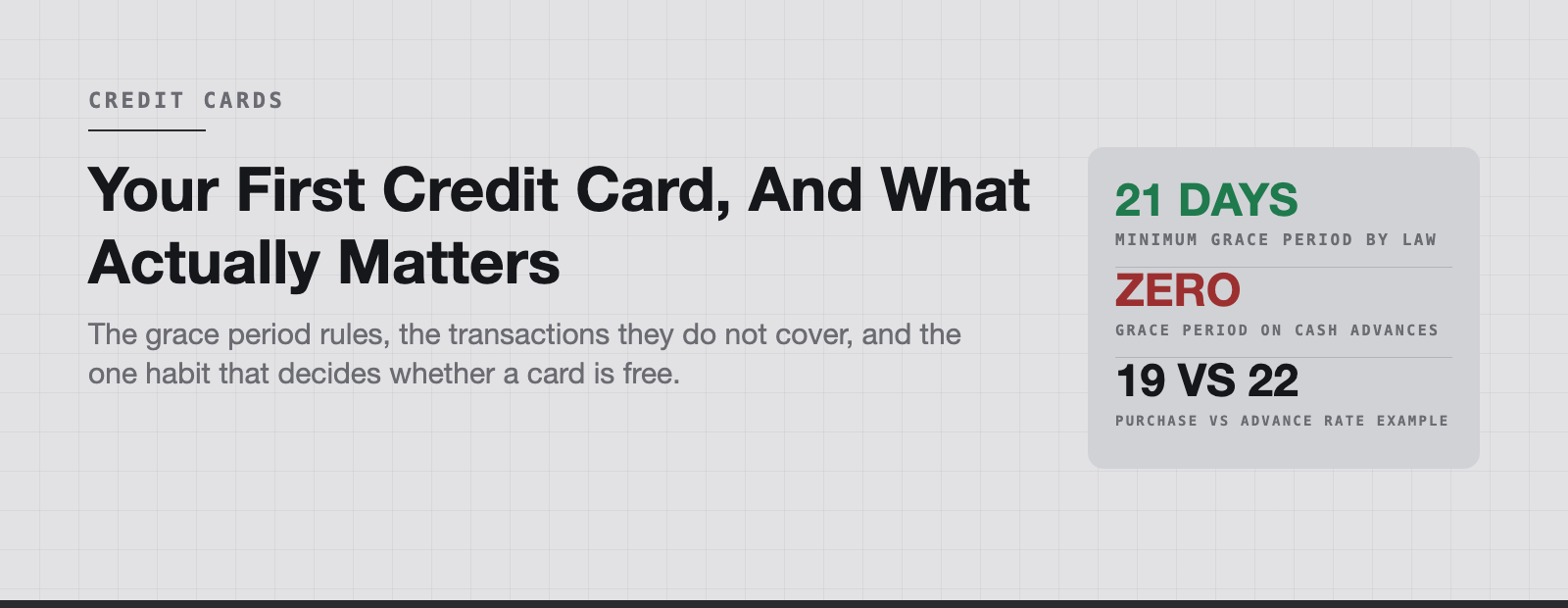
A first credit card is either free or expensive, and almost nothing about the card itself decides which. The rewards rate, the annual fee and the sign up bonus are the parts students compare. The parts that actually determine the cost are the grace period rules and whether you clear the statement balance every month, and both are set by regulation rather than by marketing.
The figures below come from the Financial Consumer Agency of Canada, which publishes the rules that federally regulated issuers must follow.
The 21 day rule, and when the clock actually starts
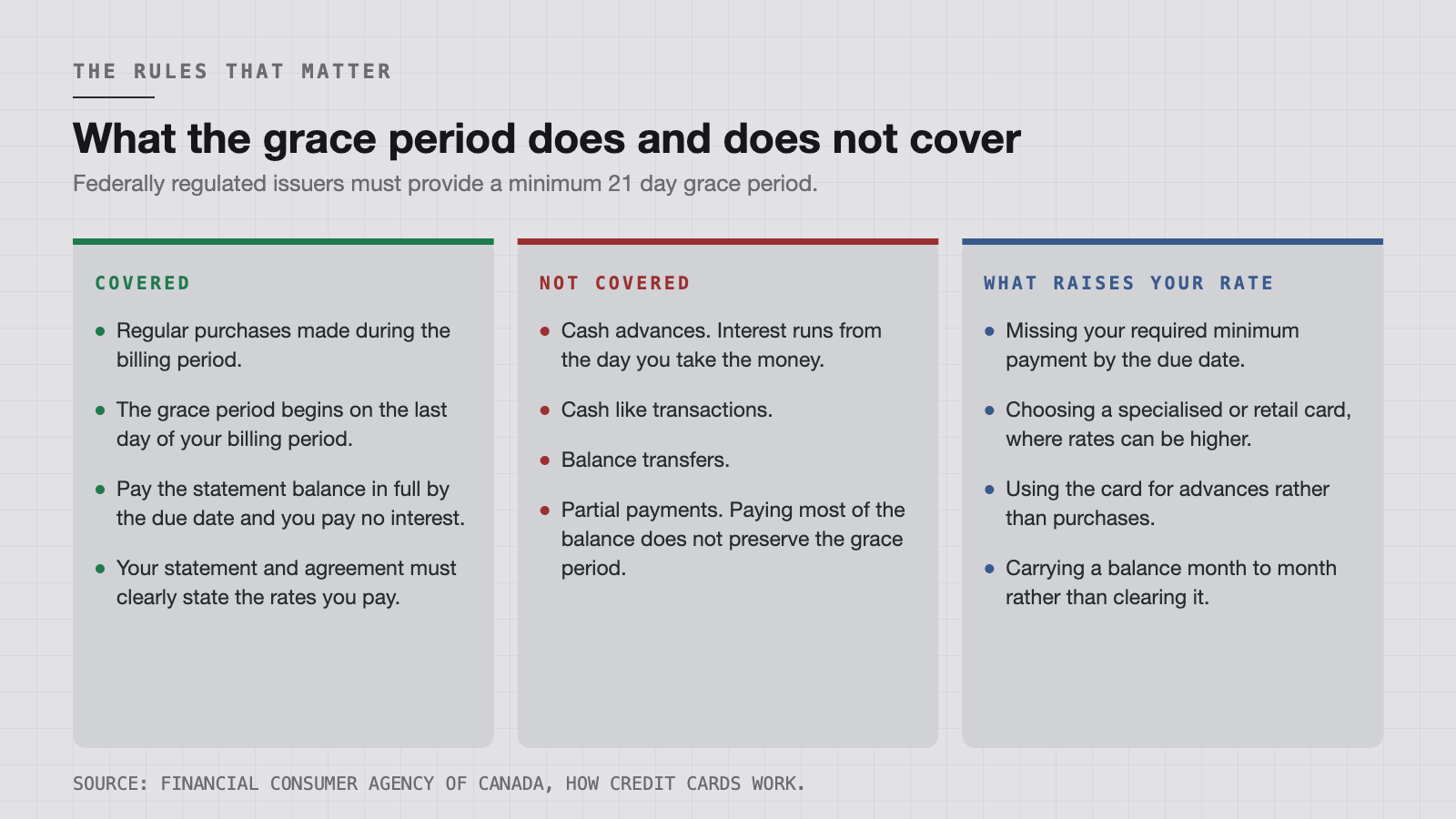
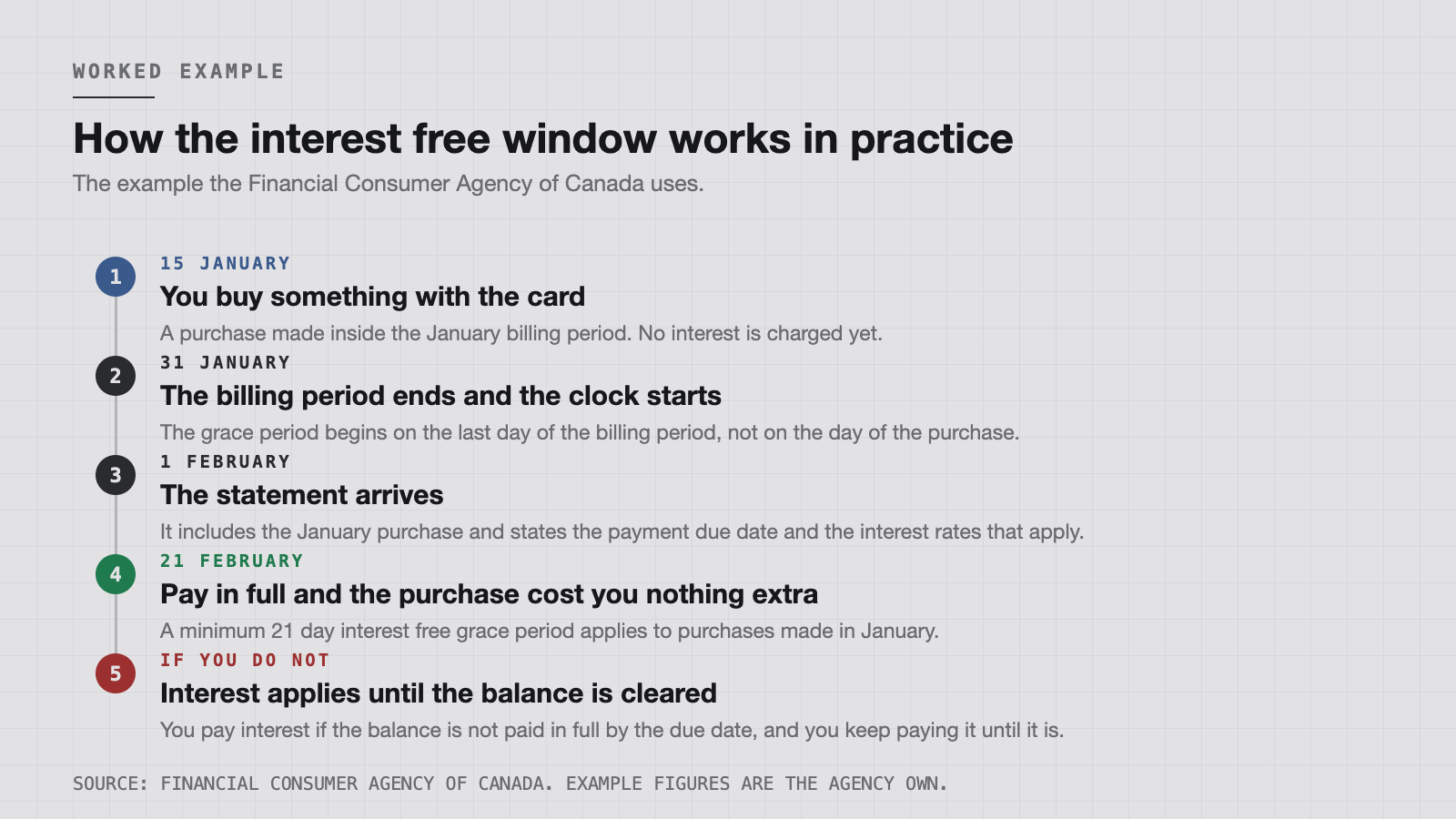
Federally regulated financial institutions must provide a minimum 21 day interest free grace period. The detail that catches people out is when it begins. The grace period starts on the last day of your billing period, not on the day you make the purchase. That means a purchase early in a billing cycle can effectively sit interest free for close to seven weeks, while a purchase made two days before the statement closes gets the minimum window.
The agency’s own example makes the mechanics concrete. Buy something on 15 January. On 1 February the January statement arrives including that purchase. A 21 day interest free grace period applies, so you have until 21 February to pay off that purchase and everything else on the statement in order to avoid interest.
The exclusions are where the real money goes
The grace period does not apply to cash advances, cash like transactions or balance transfers. For a cash advance there is no interest free period at all: you pay interest from the date you take the cash until you repay it in full, and the rate is usually higher than the purchase rate. The agency uses the example of 19 per cent on regular purchases against 22 per cent on cash advances, and notes that rates for specialised and retail credit cards may be higher again.
For a student this is the single most consequential paragraph on the subject. Taking twenty dollars out of an ATM with a credit card is a fundamentally different transaction from spending twenty dollars at a till, even though the card is the same and the amount is the same. The agency is direct that a cash advance may be a very expensive way to borrow, and suggests considering a personal loan or line of credit instead.
Paying most of it is not the same as paying all of it
You pay interest if you do not pay your balance in full by the due date, and you continue to pay it until the balance is back to zero. There is no partial credit for a partial payment as far as the grace period is concerned. A student who pays ninety per cent of a statement every month is in a materially worse position than one who pays a smaller balance in full, which is an argument for keeping the card’s use small enough that clearing it is never in doubt.
Missing the required minimum payment has a second effect beyond the immediate interest. The agency notes that your interest rate may increase if you do not make your required minimum monthly payments by the due date, and that the size of that increase can differ by card type. That is a rate change caused by behaviour, not by the market.
One more thing worth knowing about how payments are applied
Federally regulated issuers may choose how they apply your payments across the different balances on a card. If you are carrying a purchase balance at one rate and an advance balance at a higher rate, the order in which a payment is applied changes what you owe next month. That is another reason to keep a first card simple and single purpose.
What to actually compare when choosing a card
- The purchase interest rate, not the rewards rate. If you ever carry a balance, the rate dominates everything else.
- Whether there is an annual fee, and whether the fee is waived while you are a student.
- The cash advance rate, which is usually higher and has no interest free period.
- Foreign transaction costs if you plan to study or travel abroad.
- Whether the card reports to a credit bureau, since building a record is a large part of the point of a first card.
The FCAC guidance on choosing a credit card includes a comparison tool for cards available in Canada, which is a better starting point than a bank’s own product page because it lists the terms side by side.
A simple operating rule
Use the card for one recurring, predictable expense. Set the full statement balance to pay automatically from a chequing account. Never use it for cash. Under those three rules a first credit card builds a credit record at zero cost, which is exactly what it is for, and none of the interest mechanics above ever apply to you.
If you are managing this alongside a student loan, note that the interest rules are completely different. Our OSAP guide covers the six month grace period and the two separate interest treatments on the provincial and federal portions.
Sources
- the Financial Consumer Agency of Canada, Government of Canada. Minimum 21 day grace period, when the grace period begins, exclusions for cash advances and balance transfers, example rates and the effect of missed minimum payments.
- FCAC guidance on choosing a credit card. Comparison of credit card features and the credit card comparison tool.
- Financial Consumer Agency of Canada, credit cards. Overview of rights and responsibilities for credit card holders.
Details from the organizer’s page. Confirm the date, price and registration with the organizer before you go. Shown as $0.00 when the organizer lists no cost.
Posted July 28, 2026