
Every few weeks a bank announces something that sounds like bad news for anyone trying to start a career in financial services. A branch closes. A regional office consolidates. A campus program goes quiet. The instinct is to read each announcement as evidence that the whole industry is pulling back. That reading is usually wrong, and it costs students time they could be spending on applications that are still open.
The federal Job Bank labour market news service logs employer events by industry and region, and the record for finance and insurance over the first half of 2026 tells a more useful story. Retail footprints are thinning in smaller markets at the same time that specialised hubs are adding people. Both things are true at once, and knowing which side of that split an employer sits on changes how you should apply.
What the record actually shows
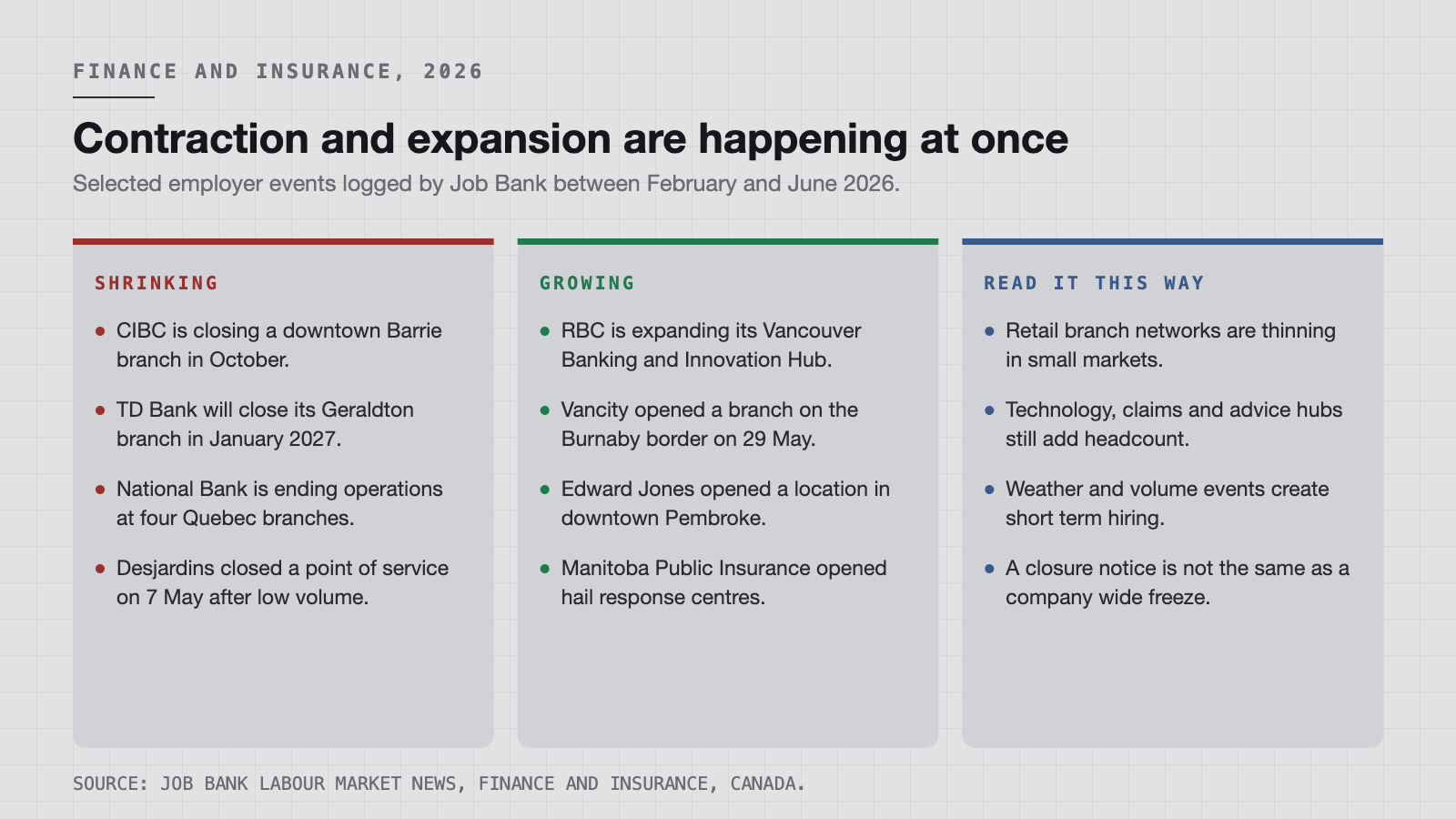
On the contraction side, Job Bank logged CIBC closing a downtown Barrie branch in October and TD Bank confirming that its Geraldton branch will close in January 2027. In Quebec, National Bank said it would cease operations at branches in Marieville, Acton Vale, Lac Etchemin and Gatineau, and Desjardins shut a point of service in the Abitibi Temiscamingue region on 7 May after transaction volumes fell too far to justify it.
On the expansion side, the same source recorded RBC expanding its Vancouver Banking and Innovation Hub with roughly 250 additional employees expected by the end of 2026. Vancity opened a branch on the boundary between Burnaby and Coquitlam on 29 May. Edward Jones opened an office in downtown Pembroke, which matters for anyone in the Ottawa Valley who assumed wealth management only hires in big cities. Manitoba Public Insurance, dealing with more than 30,000 storm related claims this year, opened temporary hail response centres in Winnipeg and offered hundreds of appointments in a matter of weeks.
Those are not contradictory signals. They describe a sector moving people out of routine transaction work and into advice, claims, technology and risk. A branch closing in a town of a few thousand people says almost nothing about whether the same employer is hiring analysts, advisers or claims staff in a regional hub.
Why closures and hiring appear together
Three forces are running at the same time. Transaction volumes keep migrating to apps, which shrinks the case for keeping small branches open. Advice, planning and claims work is harder to automate and still needs licensed people in seats. And event driven demand, such as a hail season or a flood recovery program, creates real short term roles that often become permanent for the people who perform well.
For a student, the practical consequence is that the label on a news story matters less than the function being cut or grown. A teller line being consolidated is a different event from a wealth advisory team expanding, even when both happen at the same bank in the same quarter.
How to spot a freeze before it is announced
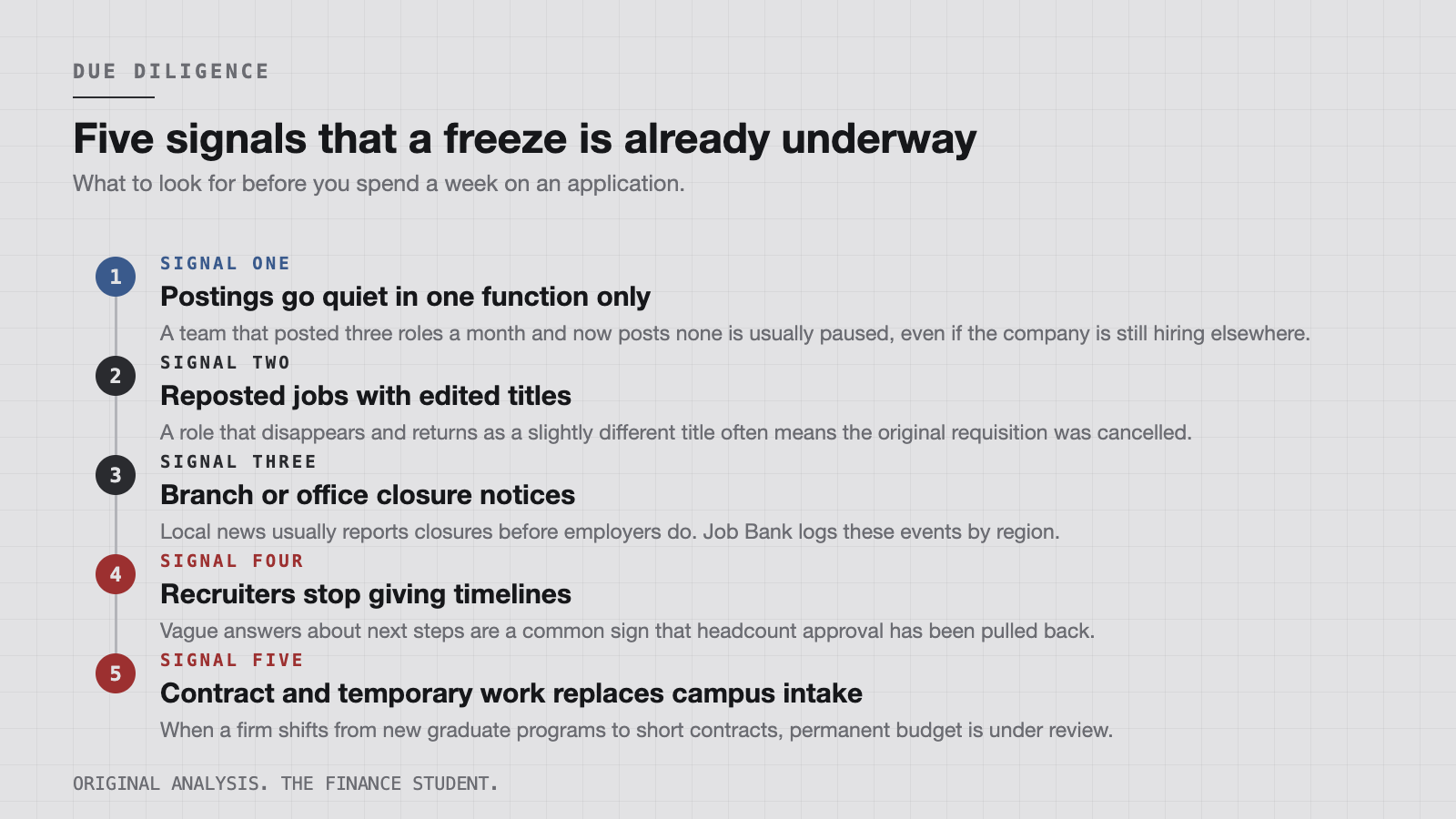
Freezes are rarely announced to candidates. They show up as silence. The pattern is consistent enough that you can usually detect it from the outside, and doing so saves you from writing tailored cover letters for requisitions that no longer have budget behind them.
- A single function goes quiet while the rest of the careers site keeps moving. That is a paused team, not a paused company.
- Roles vanish and reappear weeks later under a slightly different title. The original requisition was probably cancelled and rebuilt.
- Local news reports a closure before the employer does. Regional coverage is often the earliest public signal.
- Recruiters stop giving you dates. Vague next steps usually mean headcount approval has been pulled back upstairs.
- Campus intake is replaced by short contracts. When a firm swaps a graduate program for temporary work, the permanent budget is under review.
What to do with this information
Sort your target list by function rather than by employer. If you want retail advice work, look for employers opening or expanding locations rather than consolidating them. If you want analytical work, follow the hubs, because that is where the headcount is going. Set a calendar reminder to check Job Bank labour market news once a month for your region, filter it to finance and insurance, and read the last four weeks of events before you decide where to spend your effort.
If your own employer announces a cut while you are on a contract or a work term, ask two specific questions rather than general ones. Ask whether your function is affected or only your location, and ask whether internal transfers are open. Those answers determine whether you are looking for a new role or a new desk.
For the Ottawa specific side of this, our Ottawa new hirings page tracks entry level and student facing postings as they appear, so you can see which local employers are actually opening requisitions rather than guessing from headlines.
Sources
- Job Bank, Labour Market News, finance and insurance, Employment and Social Development Canada. Employer events for CIBC, TD Bank, National Bank, Desjardins, RBC, Vancity, Edward Jones and Manitoba Public Insurance, February to June 2026.
- Job Bank, Labour Market Information. Industry and regional filters used to compile the event list.
- Benefits Canada, coverage of the Robert Half Canada 2026 hiring report. Employer concern about salary expectations and recruiting strategy.
Details from the organizer’s page. Confirm the date, price and registration with the organizer before you go. Shown as $0.00 when the organizer lists no cost.
Posted July 28, 2026