
Three of the credentials Canadian finance students plan around have changed in the last eighteen months, and two of those changes have hard dates attached. If you are choosing between the accounting route, the investment analysis route and a securities licence, the sequencing decision you make this year is now more consequential than it was for the cohort ahead of you.
This is a summary of what each body has actually published, with the dates that affect a student rather than a mid career professional.
CPA: a new program is expected in early 2027
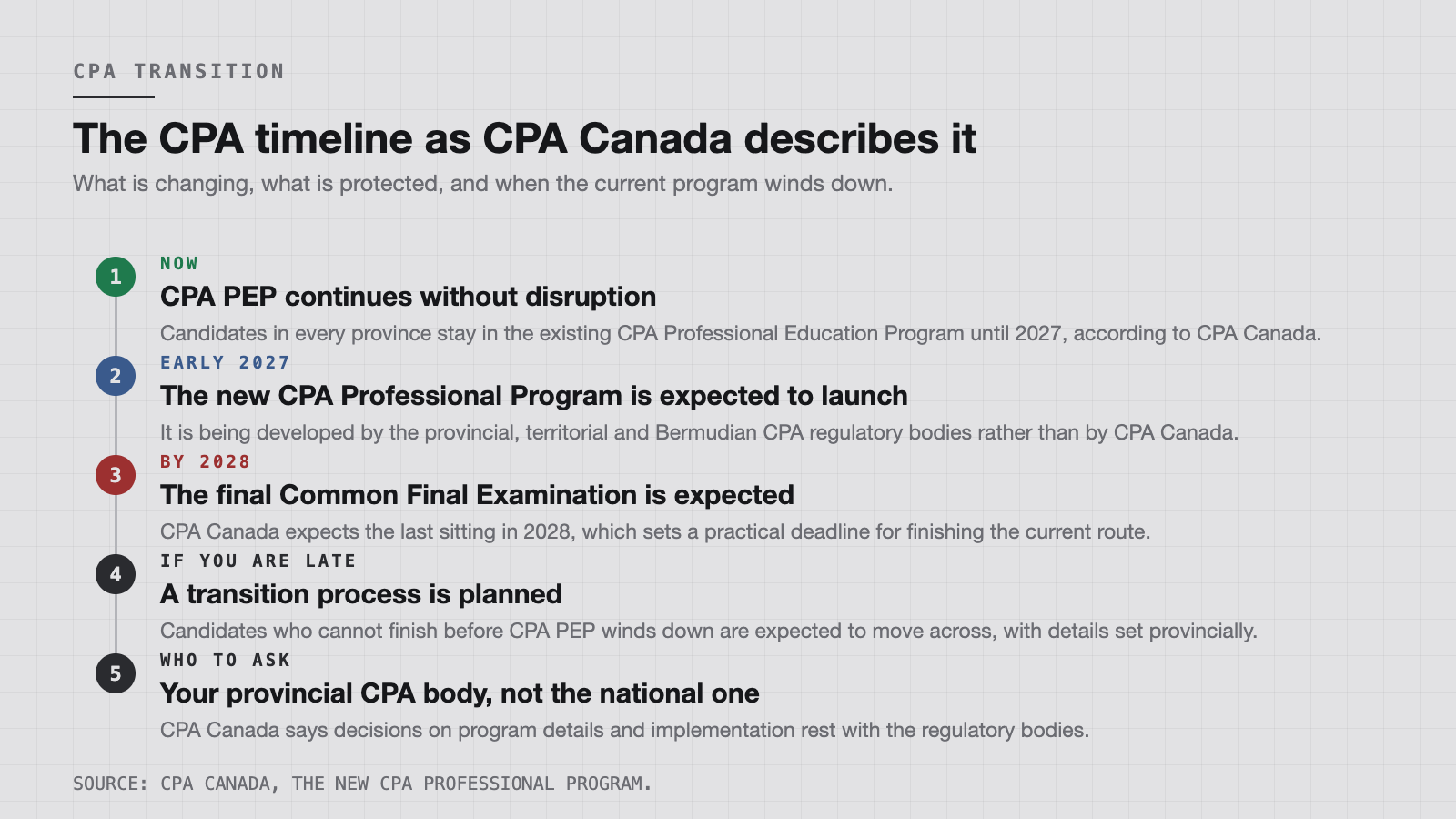
CPA Canada has confirmed that the CPA certification model is being modernised. The new program is called the CPA Professional Program, it is being developed by the provincial, territorial and Bermudian CPA regulatory bodies, and it is expected to launch in early 2027.
For current candidates the message is that nothing breaks. CPA Canada says candidates in all provinces will continue in the existing CPA Professional Education Program without disruption until 2027, and that the final offering of the Common Final Examination is expected in 2028. Candidates are encouraged to finish the existing program, and a transition process is planned for anyone who cannot meet certification requirements before CPA PEP winds down.
One detail is easy to miss and matters if you have questions. CPA Canada has said explicitly that decisions about the new program rest with the provincial and territorial regulatory bodies, not with the national organisation. If you want an answer about your own file, the useful contact is your provincial body.
What the current CPA route still looks like
If you are starting now, you are almost certainly starting in CPA PEP, so it is worth knowing the shape of it. CPA Canada describes CPA PEP as six modules: two common core modules covering financial reporting, strategy and governance, management accounting, audit and assurance, finance and taxation; two electives chosen from assurance, performance management, tax and finance; one capstone integrative module; and one capstone exam preparation module. Every module ends in an exam you must pass before moving on, and the program is designed to take two years part time while you work.
Two of those electives are gated by career choice. Assurance is mandatory for anyone heading into public accounting, and tax is mandatory for candidates on that path, which means the elective decision is really a career decision made two years early. Admission requires an undergraduate or master’s degree plus specific subject area coverage, so the prerequisite check belongs in second or third year, not in your final term.
CFA: the final level is now specialised
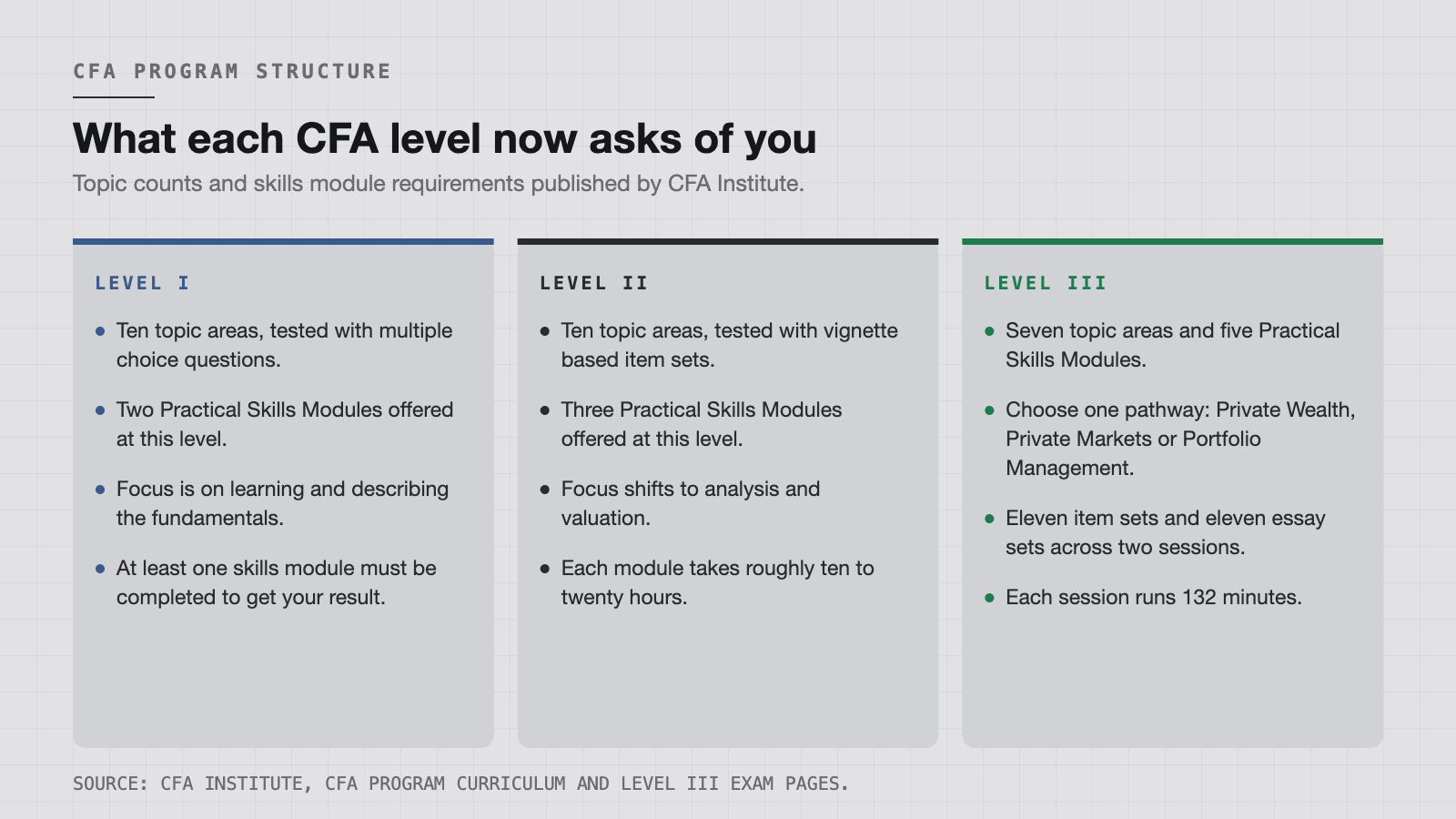
The CFA Program is still three exams, but the shape of the third one has changed. CFA Institute now offers three Level III pathways: Private Wealth, Private Markets and Portfolio Management. Candidates pick the one closest to the work they want to do, which is a genuine departure from a single common final level.
The other structural change is the Practical Skills Modules. CFA Institute states that candidates must complete at least one Practical Skills Module at each level in order to receive an exam result, and that each module takes roughly ten to twenty hours. Level I offers two modules, Level II offers three and Level III offers five. Level I and Level II each cover ten topic areas, while Level III covers seven.
The Level III exam itself is a mixed format sitting: eleven item sets and eleven essay sets, delivered in two sessions of 132 minutes each. CFA Institute suggests roughly 300 hours of preparation per level, and registration starts from USD 1,140 per exam.
Securities licensing changed in January and it is the biggest shift of the three
If your plan involves working at an investment dealer rather than in accounting or asset management, the most important change of 2026 is not CPA or CFA. As of 1 January 2026, CIRO assesses proficiency through nine examinations built on competency profiles, and the new model does not mandate a preparatory course at all. That reversed the long standing assumption that a specific course purchase was the entry ticket.
The practical consequence for students is that the Canadian Securities Course is no longer acceptable for the purposes of CIRO approval with an investment dealer, although it still supports a mutual funds licence and an exempt market representative registration with a provincial regulator. We cover the mechanics of that change, including the order the exams are usually taken in, in a separate piece on the new CIRO proficiency model.
How to sequence this if you are still in school
- Check CPA PEP subject prerequisites in second or third year. The admission requirement is a degree plus specific subject coverage, and missing courses are cheaper to fix early.
- If accounting is your route and you want the current program, work backwards from the expected final Common Final Examination in 2028.
- Do not register for a CFA level before you know which Level III pathway you are aiming at. The pathway choice shapes which electives and internships are useful.
- Budget for the Practical Skills Modules. They are a requirement for receiving your result, not an optional extra.
- If you are heading to an investment dealer, do not buy a securities course on the assumption it licenses you. Confirm what CIRO requires for the specific approval category first.
For local context on which employers are hiring into these routes right now, see our Ottawa new hirings page.
Sources
- CPA Canada, The new CPA Professional Program. Expected launch in early 2027, CPA PEP continues until 2027, final Common Final Examination expected 2028.
- CPA Canada, CPA Professional Education Program. Module structure, electives and admission requirements.
- CFA Institute, CFA Program curriculum. Topic counts by level and the Practical Skills Module requirement.
- CFA Institute, CFA Program Level III exam. Specialised pathways and exam format.
- CIRO, Exam Hub. Nine proficiency examinations effective 1 January 2026.
- Canadian Securities Institute, Canadian Securities Course. Notice that the course is no longer acceptable for CIRO investment dealer approval.
Details from the organizer’s page. Confirm the date, price and registration with the organizer before you go. Shown as $0.00 when the organizer lists no cost.
Posted July 24, 2026