Most coverage of tuition changes focuses on the headline percentage, which is the least useful number for a student already enrolled. The changes that actually alter what a year costs you are quieter: what your institution is now required to disclose, how ancillary fees are published, and whether the materials on your syllabus can be bought second hand.
Two of those changed recently in Ontario, and both are now in force. Neither was announced in a way that reached students.
Your syllabus now has to price your textbooks
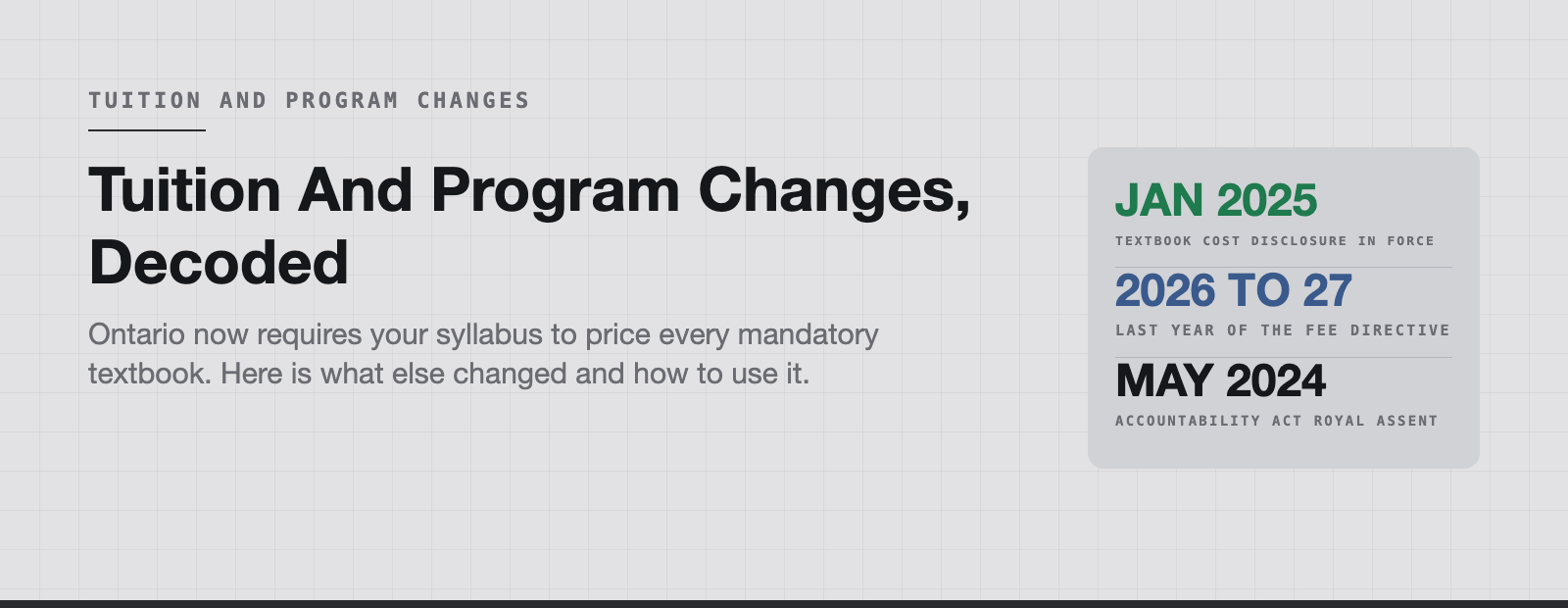
The Strengthening Accountability and Student Supports Act, 2024 received Royal Assent on 16 May 2024 and amended the Ministry of Training, Colleges and Universities Act with new requirements for Ontario’s publicly assisted colleges and universities. the Minister’s revised directive on the costs of educational materials implements part of that, and it replaced an earlier directive issued in August 2024. It is effective for all courses beginning in or after January 2025 and remains in force until revoked or replaced.
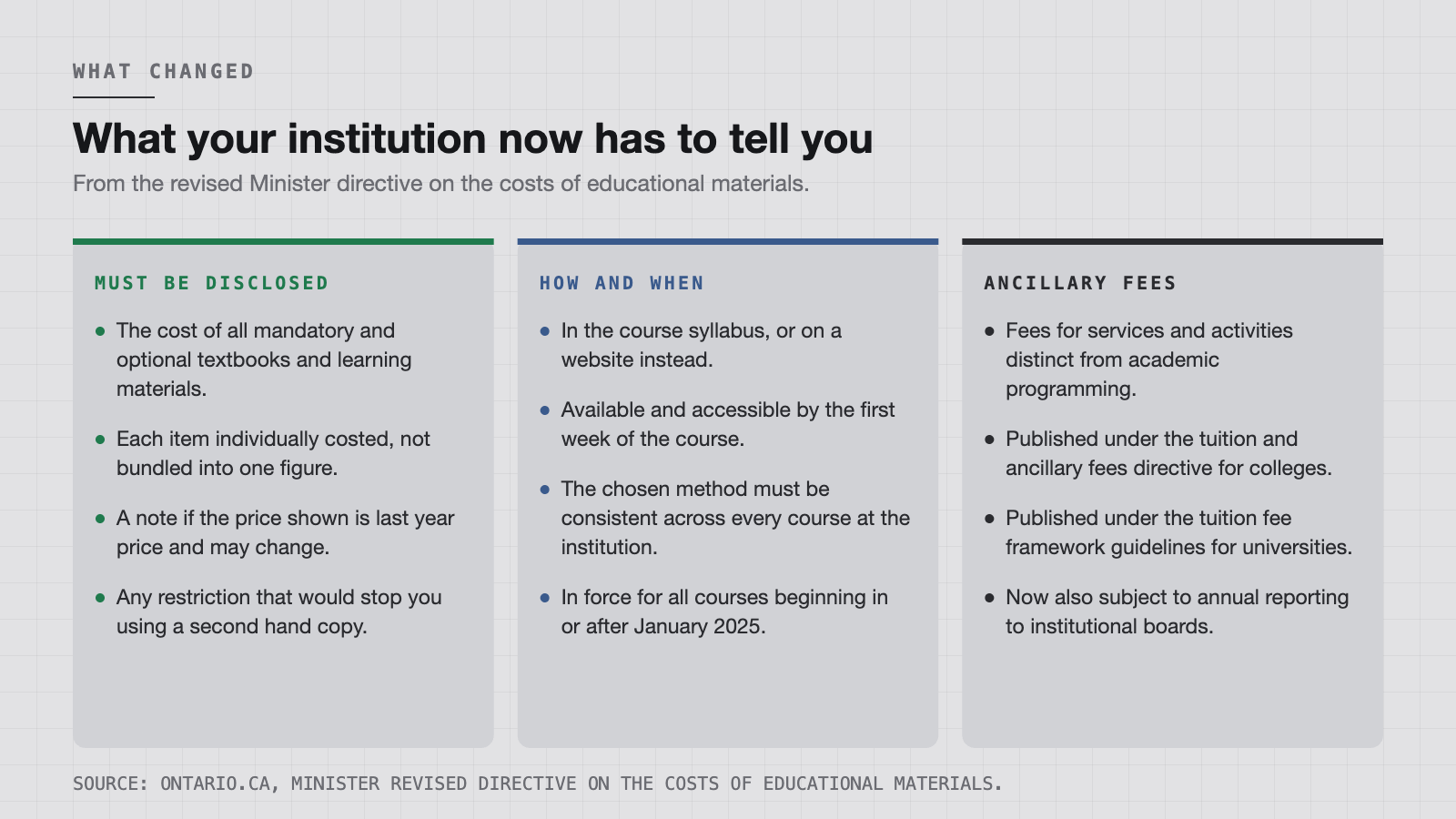
The substance is specific. Every publicly assisted college and university must ensure students are informed of the costs of all textbooks and other learning materials, both mandatory and optional, in the course syllabus. Each item should be individually costed. Where the current year price is not available when the syllabus is prepared, the most recent price should be shown with a note that it may change. And critically, the syllabus should state whether there are any restrictions that would prevent a student from using a second hand copy.
That last requirement is the one worth acting on. A textbook with a single use online access code is not a two hundred dollar cost you can halve on a resale site, it is a two hundred dollar cost every term it is assigned. Institutions are now obliged to tell you which of your materials fall into that category before you commit.
Institutions can use a website instead, with conditions
The directive allows an institution to publish this information somewhere other than the syllabus, such as a website, but attaches two conditions. The information must be readily available and accessible by the first week of the course, and the method of communication must be consistent for all courses offered at the institution. If you cannot find costed materials for one course, the more likely explanation is that you are looking in the wrong place than that the course is exempt.
Ancillary fees are published separately, and now reported annually
Ancillary fees are defined as fees charged to support services and activities distinct from academic programming or general institutional overhead, in addition to tuition. They are published under the tuition and ancillary fees policy framework for colleges for colleges, and under the tuition fee framework implementation guidelines for publicly assisted universities. The revised directive did not change the publication requirements themselves, but it did add annual reporting to institutional boards.
For a student the practical point is that tuition and ancillary fees are two different documents. Comparing programs on tuition alone is comparing incomplete figures, and the gap between the two is often large enough to change which option is cheaper.
The college fee directive runs to 2026 and 2027
The Minister’s Binding Policy Directive governing tuition and ancillary fees at colleges, in its August 2024 form, is effective for the 2023 to 2024 through 2026 to 2027 academic years. That matters for planning in one specific way: the current framework has a defined end point, which means the year after next is the point at which a new framework becomes possible. If you are choosing between finishing a program sooner or extending it, that is a reason to prefer sooner.
Program changes matter more than fee changes
The change most likely to cost you a term is not financial. It is a prerequisite being restructured, a required course moving to alternate year delivery, or a specialisation being retired. Fee increases are annoying and predictable. A missing required course in your final year adds four months and a term of living costs.
Ask your department three questions in writing before registration closes. Ask whether every course required for your specialisation is offered in the next twelve months. Ask whether any prerequisite chain is changing. Ask what happens to your requirements if a course is cancelled. Written answers are worth keeping.
The audit, in order
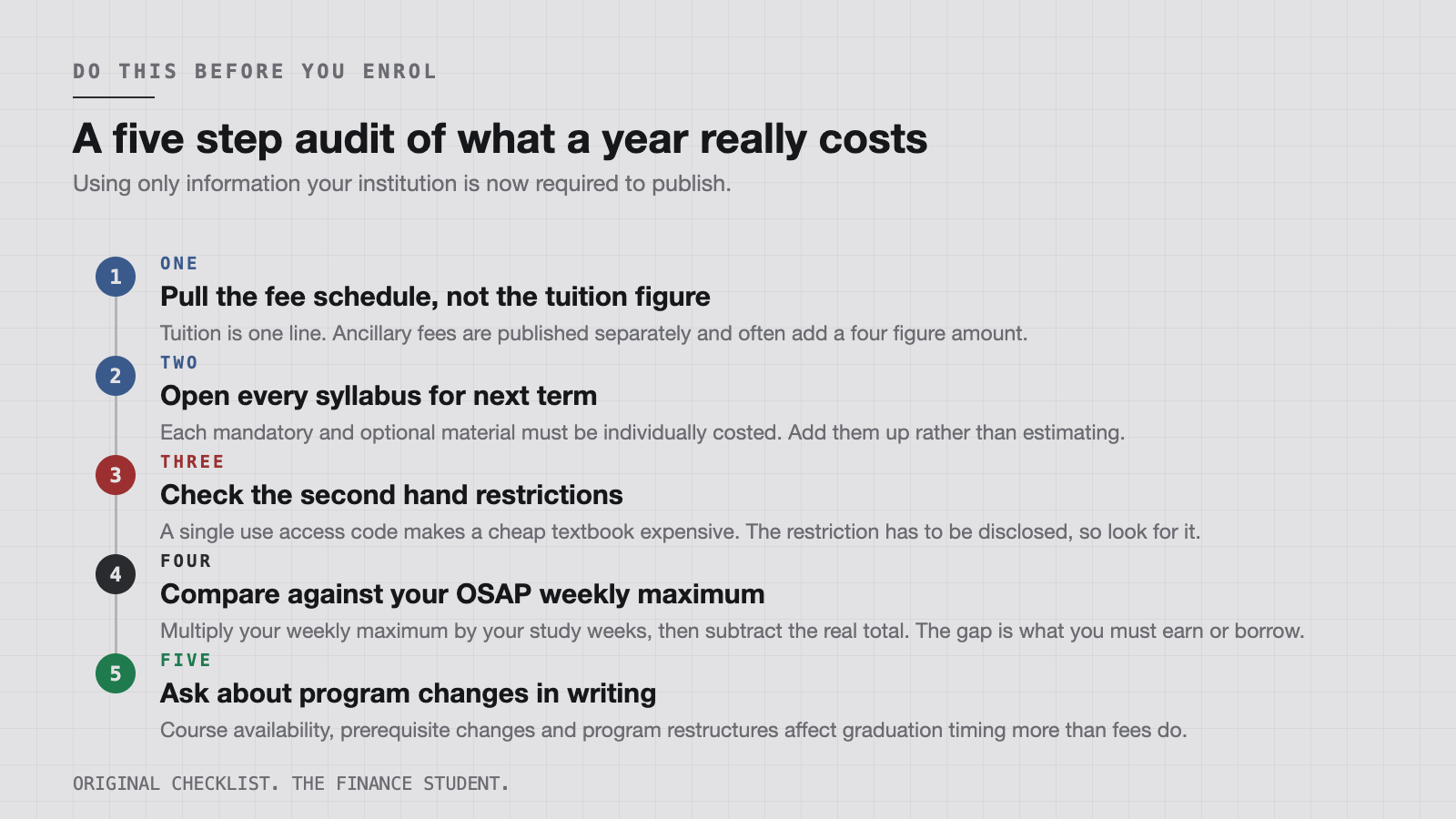
- Download the tuition schedule and the ancillary fee schedule as separate documents.
- Open every syllabus for next term and add up the individually costed materials.
- Flag anything with a restriction on second hand use, because that cost cannot be reduced.
- Multiply your OSAP weekly maximum by your number of study weeks and subtract the real total.
- Get written confirmation that the courses you need to graduate will be offered.
For the funding side of that calculation, see our guide to what OSAP actually pays in 2026 and 2027.
Sources
- the Minister’s revised directive on the costs of educational materials, Ontario Ministry of Colleges and Universities. Disclosure of mandatory and optional material costs, individual costing, second hand restrictions, the website alternative and the January 2025 effective date.
- tuition and ancillary fees policy framework for colleges. Definition and publication of ancillary fees, and the directive term covering 2023 to 2024 through 2026 to 2027.
- Ontario.ca, maximum amounts of aid. OSAP weekly maximums used in the affordability comparison.
Details from the organizer’s page. Confirm the date, price and registration with the organizer before you go. Shown as $0.00 when the organizer lists no cost.
Posted July 25, 2026