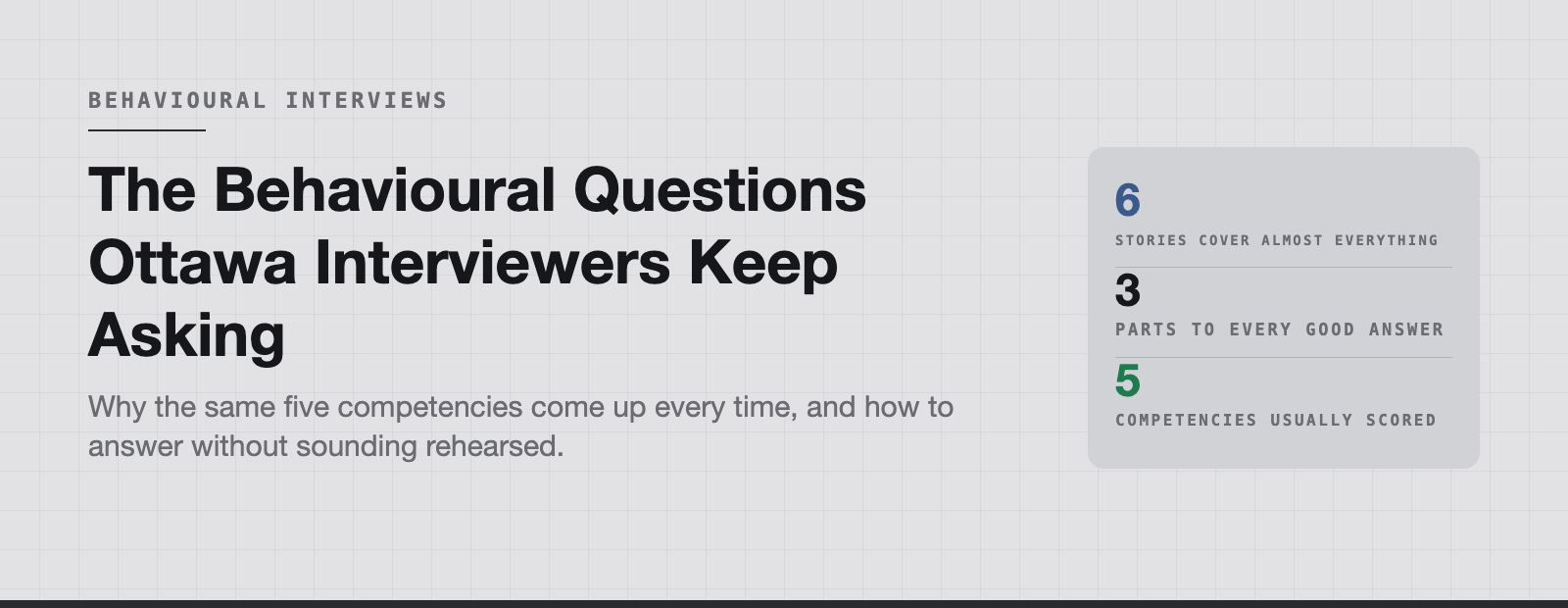
Behavioural questions feel random when you are on the receiving end of them. They are not. In most cases the employer has already decided which characteristics matter for the role, written them down as a competency list, and then built open ended questions to draw evidence against each one. Once you know that, the interview stops being a memory test and becomes a matter of supplying the right evidence.
Harvard’s Mignone Center for Career Success describes the premise directly: the principle behind a behavioural interview is that past behaviour is a good predictor of future behaviour. The centre notes that employers usually predetermine a specific set of competencies required to succeed in the role, with examples including problem solving, teamwork, communication, writing skills and leadership, and then design questions that ask you to describe a particular situation and your actions in it.
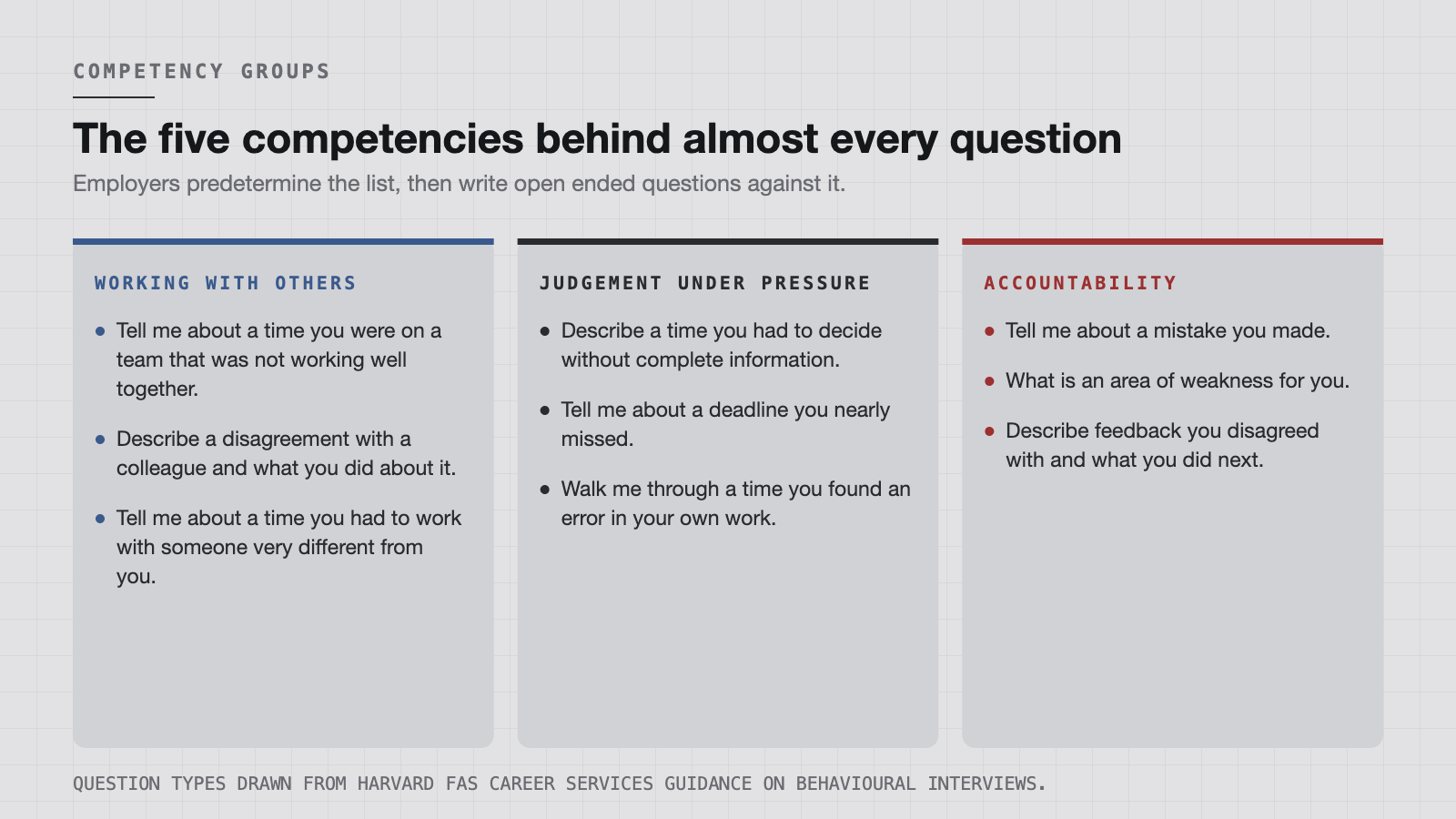
The same three or four competencies, phrased differently
Across entry level finance interviews in Ottawa, the questions cluster tightly. Working with others is almost always tested, usually through a question about a team that was not functioning or a colleague you disagreed with. Judgement under pressure appears as a deadline, an incomplete set of information, or an error you caught in your own work. Accountability shows up as a mistake you made or a weakness you hold. Communication is rarely a separate question because it is being scored continuously while you answer everything else.
That clustering is why a story bank beats a script. Six well chosen experiences will cover the whole list, because a single experience can serve as a teamwork answer or an accountability answer depending on which part of it you foreground.
Three parts, and the one most candidates skip
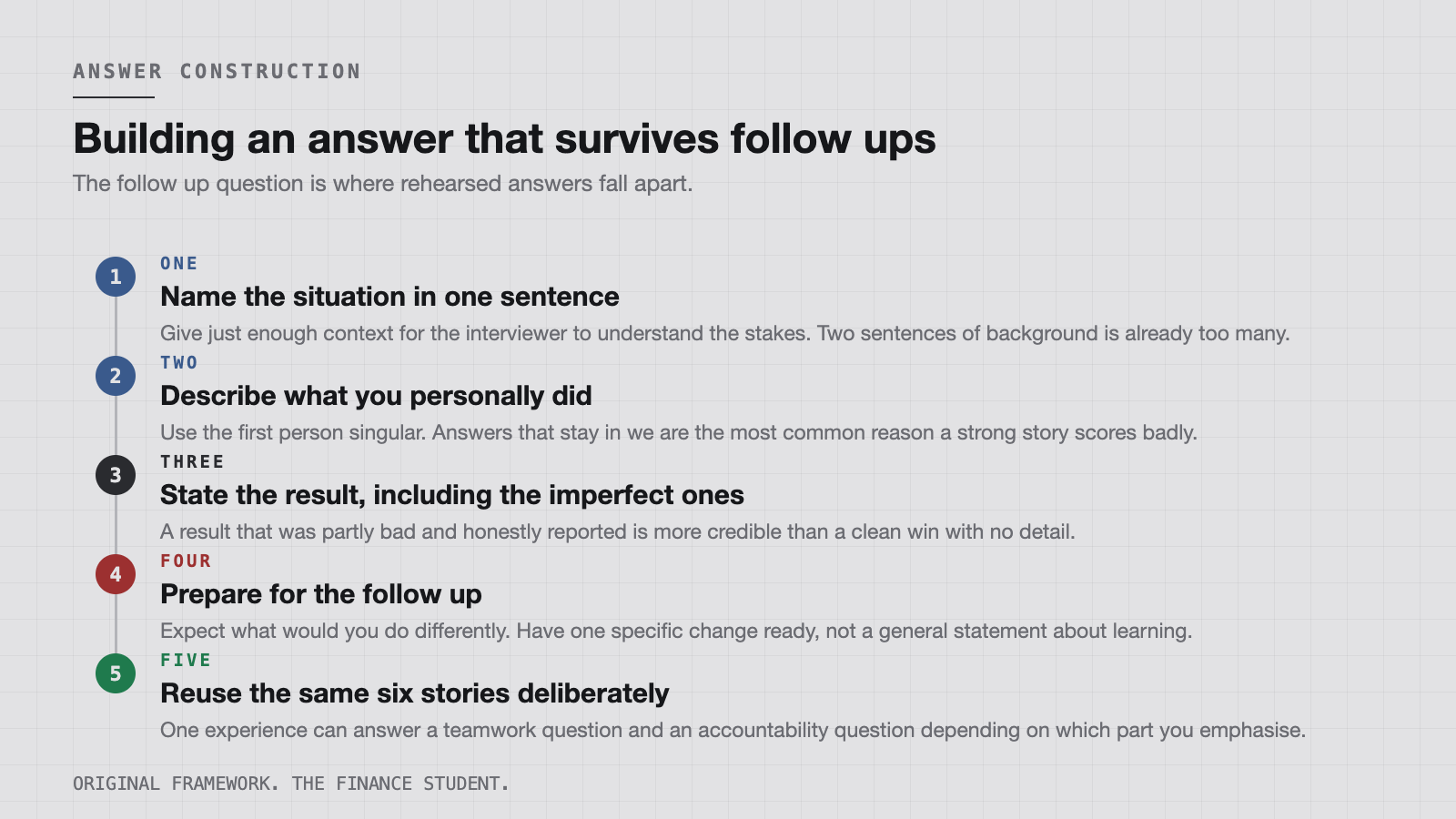
Harvard’s guidance on answering a behavioural question is to think about the situation you want to describe, the actions you took related to the question asked, and the result based on that action. Almost every candidate covers the situation. Most cover the result, at least loosely. The part that gets skipped is the middle one, and it is the only part being scored.
The specific failure is grammatical. Candidates describe what the group did rather than what they did. An interviewer taking notes against a competency list cannot credit you for a decision made by an unnamed we. Say what you personally decided, said or built, even when the work was genuinely collaborative. This is not boasting, it is the only way the evidence lands.
The negatively framed questions
Questions such as tell me about a time you made a mistake, or what is an area of weakness for you, are the ones that separate candidates. Harvard’s advice is that these are asked to understand how you handle challenging situations and to gauge how much insight you have into yourself. The recommended approach is to be honest, take responsibility for mistakes, be accountable about areas needing improvement, focus on behaviours rather than personality traits, and describe how you are working on the weakness.
The behaviour versus trait distinction is the useful part. Saying you are a perfectionist is a trait claim and reads as evasion. Saying that you used to review your own numbers only once and now build a second check into every model is a behaviour claim with a correction attached, which is exactly what the question is fishing for.
Prepare for the follow up, not the question
The question you rehearsed is rarely where a candidate comes apart. The follow up is. Expect some version of what would you do differently, or what did the other person think. Have one specific change ready for each of your six stories. A general statement about learning from the experience signals that the story was assembled for the interview rather than lived.
A short list of what to prepare
- Six experiences that differ in kind: leading something, fixing a mistake, handling a difficult person, handling money or numbers carefully, learning fast, and failing then adjusting.
- One sentence of situation for each. If you need three sentences of context, pick a different story.
- First person verbs throughout the action section.
- An honest result, including the parts that did not work.
- One concrete change you made afterwards, ready for the follow up question.
If you want the wider preparation frame around these questions, including the technical half of a finance interview and how to answer the salary question with published wage data, see our interview prep guide for Ottawa finance roles. For employers currently posting entry level and student facing roles, see the Ottawa new hirings page.
Sources
- Harvard FAS, Mignone Center for Career Success, Interviewing. Behavioural and fit interviews, the competency model behind them, the situation and action and result structure, and guidance on answering negatively framed questions.
- Job Bank, prepare for an interview, Employment and Social Development Canada. Canadian interview preparation guidance.
Details from the organizer’s page. Confirm the date, price and registration with the organizer before you go. Shown as $0.00 when the organizer lists no cost.
Posted July 23, 2026