OSAP is the largest single number in most Ontario finance students’ personal balance sheet, and it is also the one they understand least precisely. The application is designed so that you do not need to know the mechanics in order to receive money. That is convenient in September and expensive later, because the terms of the loan portion decide what your first two years after graduation look like.
Everything below is from Ontario’s own published figures for the 2026 to 2027 academic year. Nothing here is an estimate.
OSAP is paid as a weekly maximum, not a lump sum
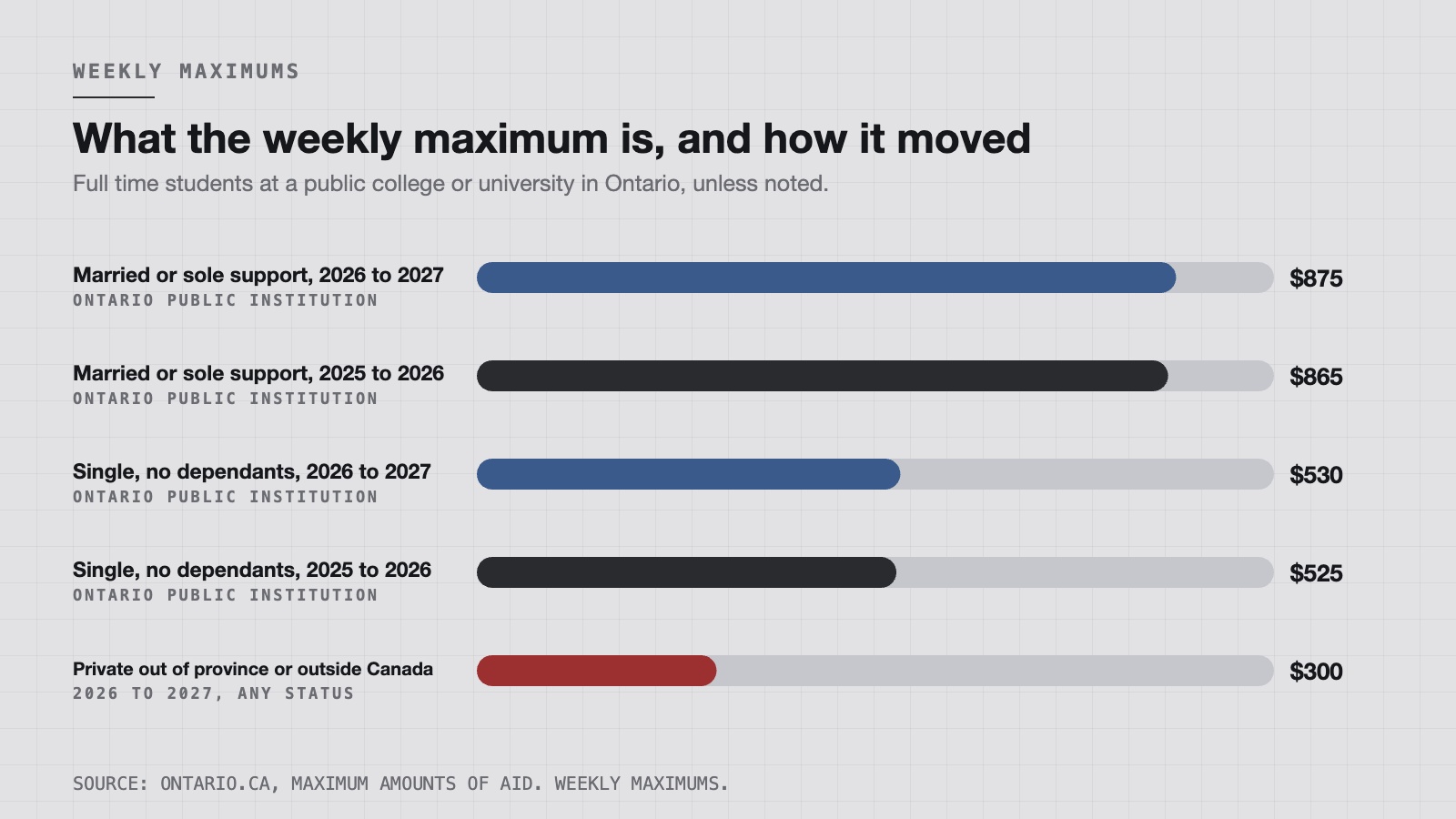
This is the detail that surprises people. Aid for full time students is expressed as a weekly maximum tied to the length of your study period. According to Ontario’s published maximum amounts of aid, for 2026 to 2027 a single student with no dependants attending a public college or university in Ontario has a weekly maximum of $530. A student who is married, in a common law relationship, or a sole support parent has a weekly maximum of $875.
Those figures moved up from the previous year, when the equivalents were $525 and $865 per week. The same $530 and $875 maximums apply to approved private postsecondary schools in Ontario and to public colleges and universities in other Canadian provinces. The number drops sharply, to $300 per week, for private postsecondary schools in another province and for any private or public school outside Canada.
Ontario also notes that you may receive more than the listed amounts, and that you will only know your actual entitlement once your full time application has been processed. Treat the weekly maximum as a ceiling for planning, not as a promise.
The federal grants sit on top
The provincial figures are only part of the package. Ontario lists three Canada Student Grants that may increase your aid: the grant for full time students, with a maximum of $6,300 per academic year subject to a weekly maximum; the grant for students with disabilities, at a maximum of $2,800 per academic year; and the grant for full time students with dependants, at $280 per child per month.
Grants do not have to be repaid, which makes the distinction between the grant and loan portions of your assessment the single most useful thing to look up in your own OSAP account. Two students receiving identical totals can have very different debts.
Repayment: six months, and two different interest treatments
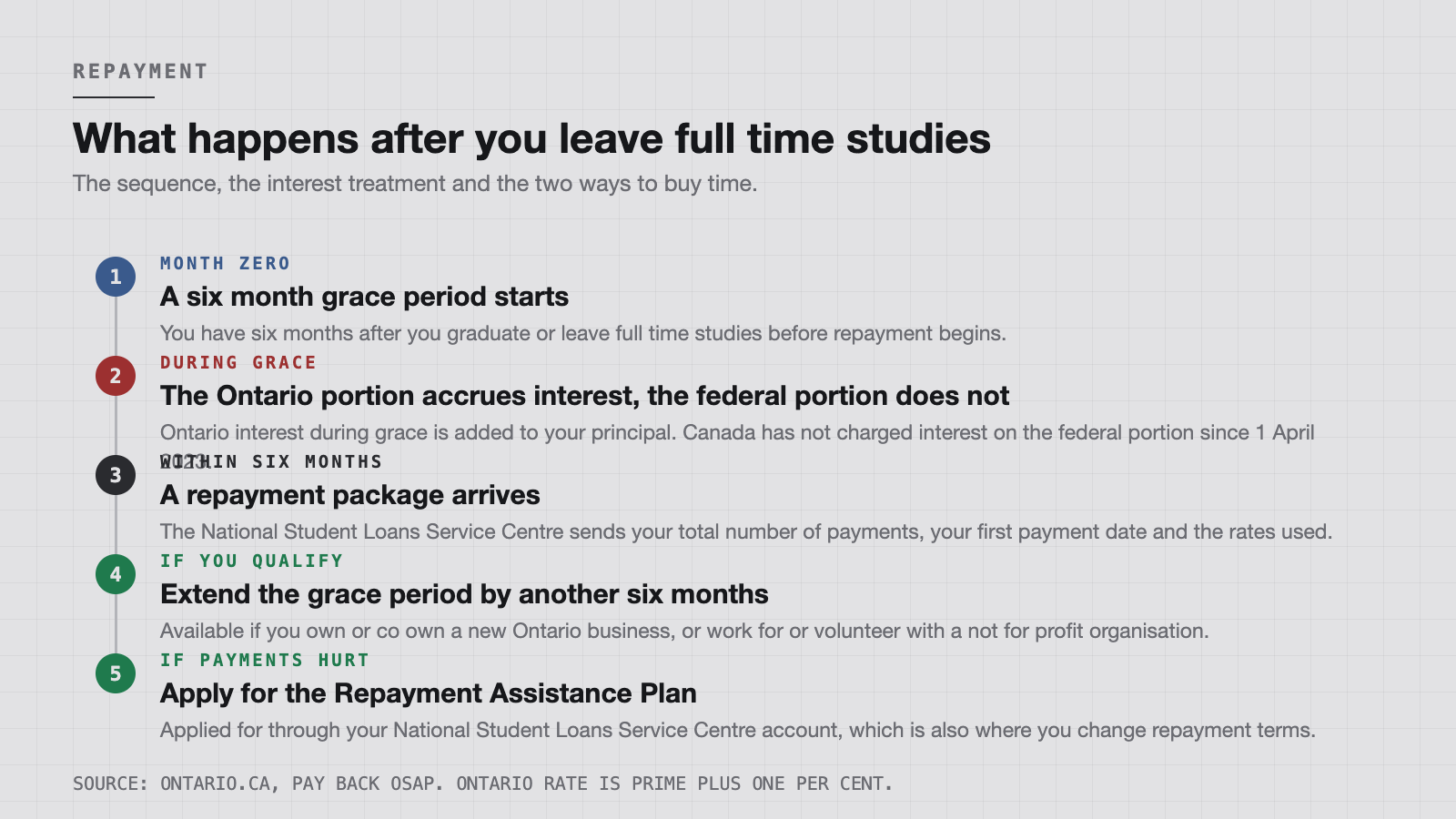
According to Ontario’s guidance on paying back OSAP, you have six months after you graduate or leave full time studies before you need to start repaying. Interest treatment during that window is asymmetric and this is the part most graduates get wrong. Ontario charges interest on the Ontario portion of your loan during the six month grace period, and that interest is added to your principal. Canada, effective 1 April 2023, does not charge interest on the federal portion at all.
Once repayment begins, the Ontario interest rate is calculated at prime plus one per cent and the Canada rate is zero per cent. Ontario notes that if rates change your monthly payment stays the same, but the share of each payment going to principal changes. Your repayment package, including your total number of payments, your first payment date and the rates used, arrives from the National Student Loans Service Centre within six months of leaving studies.
Two ways to buy time, both underused
Ontario allows the grace period to be extended by another six months if you own or co own a new business in Ontario, or if you work for or volunteer with a not for profit organisation. That is a genuinely useful provision for graduates doing unpaid or low paid work in the sector, and almost nobody asks about it.
The second is the Repayment Assistance Plan, applied for through your National Student Loans Service Centre account. The same account is where you check balances, update contact details and request a change to your repayment terms. Setting it up before your first payment date is much easier than doing it after a missed payment.
What to do this term
- Open your OSAP account and write down the grant portion and the loan portion separately.
- Multiply your weekly maximum by the number of weeks in your study period so you know your ceiling.
- Note the date six months after your expected graduation. That is when repayment starts, not when your degree is conferred.
- If you plan to start a business or work at a not for profit after graduation, look up the grace extension before you need it.
- Create your National Student Loans Service Centre account while you are still in school rather than during your grace period.
If you are also weighing your first credit card while carrying OSAP, our guide to what actually matters on a first credit card covers the grace period rules that work very differently from student loans.
Sources
- Ontario’s published maximum amounts of aid, Ontario Ministry of Colleges and Universities. Weekly maximums for 2026 to 2027 and 2025 to 2026, and Canada Student Grant maximums.
- Ontario’s guidance on paying back OSAP. Six month grace period, interest treatment, prime plus one per cent, grace extension conditions and the Repayment Assistance Plan.
- Ontario.ca, OSAP: Ontario Student Assistance Program. Application process and eligibility overview.
Details from the organizer’s page. Confirm the date, price and registration with the organizer before you go. Shown as $0.00 when the organizer lists no cost.
Posted July 29, 2026