
Co-op deadlines are unforgiving in a way that most university deadlines are not. A late essay costs you marks. A late co-op application costs you a full cycle, and because work terms are sequenced against academic terms, one missed cycle can push your first paid finance role back by eight months or more.
The dates below are drawn from what Ottawa area institutions have published for the current cycle. Treat them as the shape of the process rather than as a universal calendar, because entry points differ by program and every institution runs its own portal.
The date that matters most this month
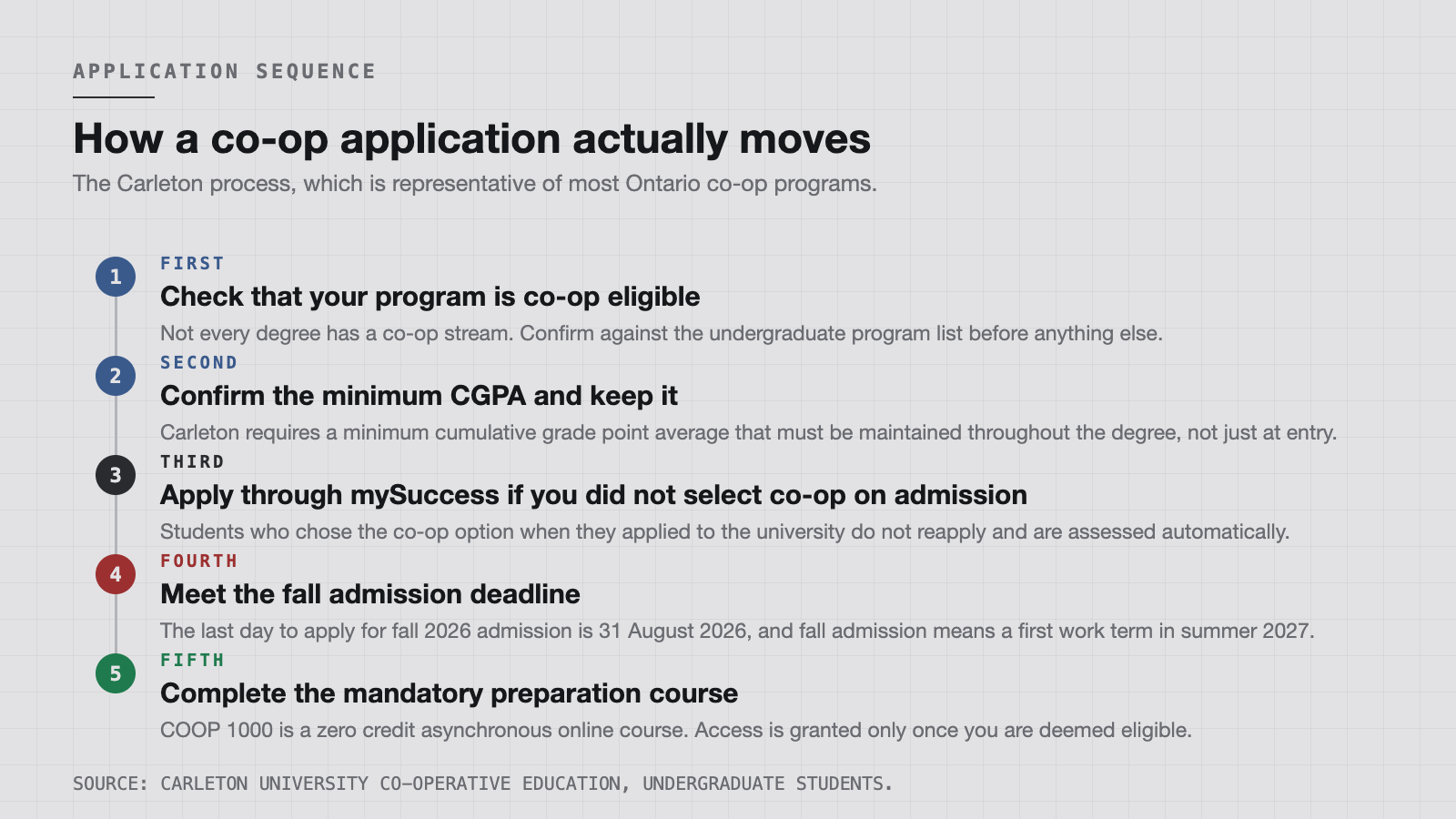
Carleton’s Co-operative Education office has confirmed that applications for fall 2026 admission are open through mySuccess and that the last day to apply is 31 August 2026. Fall admission means your first work term falls in summer 2027. That single sentence contains the planning problem in miniature: the deadline is this month, and the payoff is nearly a year away.
Carleton also notes that students who selected the co-op option when they originally applied to the university do not need to reapply through mySuccess. Their eligibility is reviewed automatically before their program’s first entry point and the decision is emailed to their university account. Students who apply later in the cycle may be decided in a second round, with those decisions communicated by mid September.
Eligibility is a standing requirement, not a one time test
The most common misunderstanding is that co-op eligibility is checked once. It is not. Carleton states that co-op eligibility criteria include a minimum cumulative grade point average that must be maintained throughout the degree. A weak term after you are admitted can remove you from the program, and it usually happens quietly rather than with a warning.
There is also a mandatory preparation course. COOP 1000 is a zero credit asynchronous online course, which means it does not appear on your timetable and does not conflict with classes, but access is only granted once you are deemed eligible to participate. Students who assume it is optional lose their placement eligibility for the term.
What to have ready before you apply
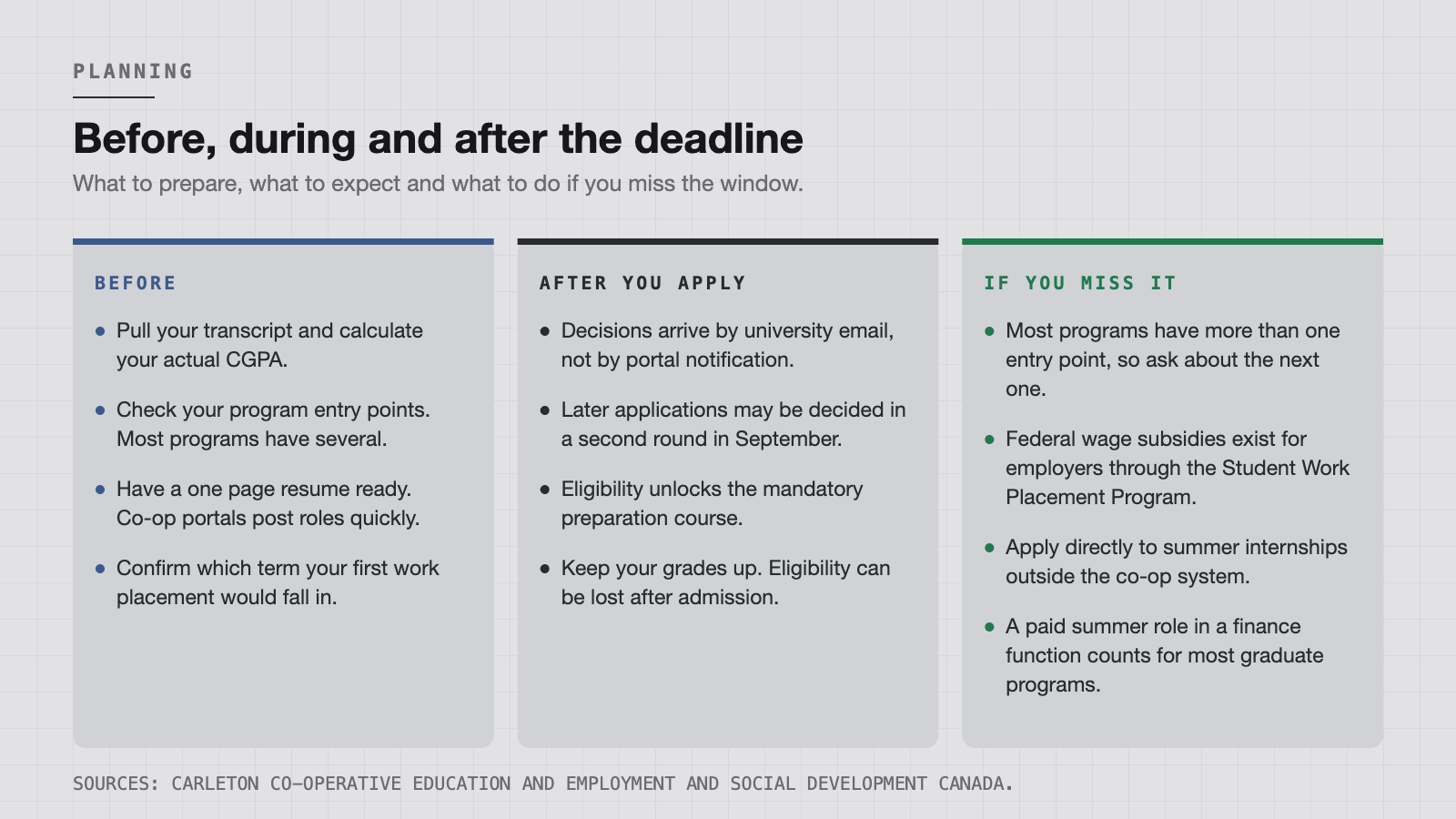
- Your real cumulative grade point average, calculated from your transcript rather than estimated from memory.
- Confirmation that your specific program has a co-op stream, and which entry points apply to it.
- A one page resume in final form. Co-op portals open and close postings quickly, and there is rarely time to write one from scratch.
- A short list of the finance functions you actually want, because co-op postings are described by function rather than by employer brand.
- Your university email set up on your phone. Decisions arrive by email, not through the portal.
If you miss the window
Missing a co-op deadline is recoverable, and the recovery route is usually better than students expect. Most programs have more than one entry point, so the first question to ask your co-op office is when the next assessment happens rather than whether you can appeal the last one.
The second route is to apply directly for summer internships outside the co-op system. Employers have a financial incentive to hire students through the federal Student Work Placement Program, which provides wage subsidies to employers offering student placements through recognised Employer Delivery Partners. Employment and Social Development Canada includes co-op placements, internships, practicums and mentorship programs in the definition of a student work placement, so a direct hire internship can attract the same subsidy as a formal co-op term.
That is a useful thing to know when you email a small firm that has never hired a student. You are not only asking for work experience, you are pointing them at a program that reduces the cost of giving it to you.
How to keep the calendar honest
Set three reminders rather than one. Set the first two weeks before the application deadline so you have time to fix a missing document. Set the second for the week decisions are expected, because you will need to act quickly if you are placed in a second round. Set the third for the start of the term before your work term, since that is when most postings open.
For Ottawa employers currently posting entry level and student facing roles, see our Ottawa new hirings page.
Sources
- Carleton University, Co-operative Education, Undergraduate Students. Fall 2026 application deadline of 31 August 2026, first work term in summer 2027, mySuccess process, minimum CGPA requirement and the mandatory COOP 1000 course.
- Carleton University, Co-operative Education. Program eligibility and entry points.
- Employment and Social Development Canada, Student Work Placement Program. Wage subsidies and the definition of a student work placement.
Details from the organizer’s page. Confirm the date, price and registration with the organizer before you go. Shown as $0.00 when the organizer lists no cost.
Posted July 26, 2026