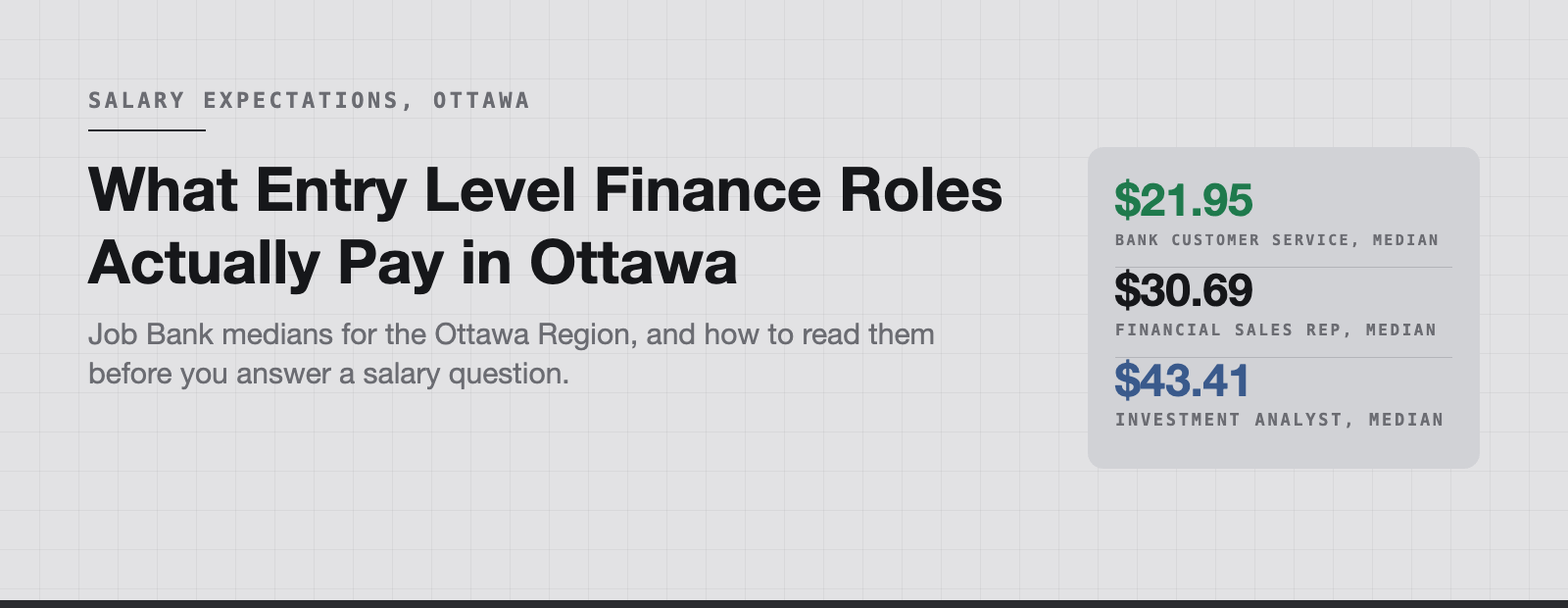
The most uncomfortable moment in an entry level interview is the salary question, and it is uncomfortable mostly because students answer it without data. Job Bank publishes wage ranges by occupation and by region, which means there is a public number for almost every finance job a student in Ottawa is likely to apply for. Knowing those numbers will not get you a higher offer on its own, but it stops you from naming a figure that is either unserious or well below what the role pays.
Everything below comes from Job Bank wage reports for the Ottawa Region. The underlying data is the Labour Force Survey run by Statistics Canada, with a reference period of 2023 to 2024. Job Bank publishes three figures for each occupation: a low, a median and a high hourly wage.
The Ottawa numbers, role by role
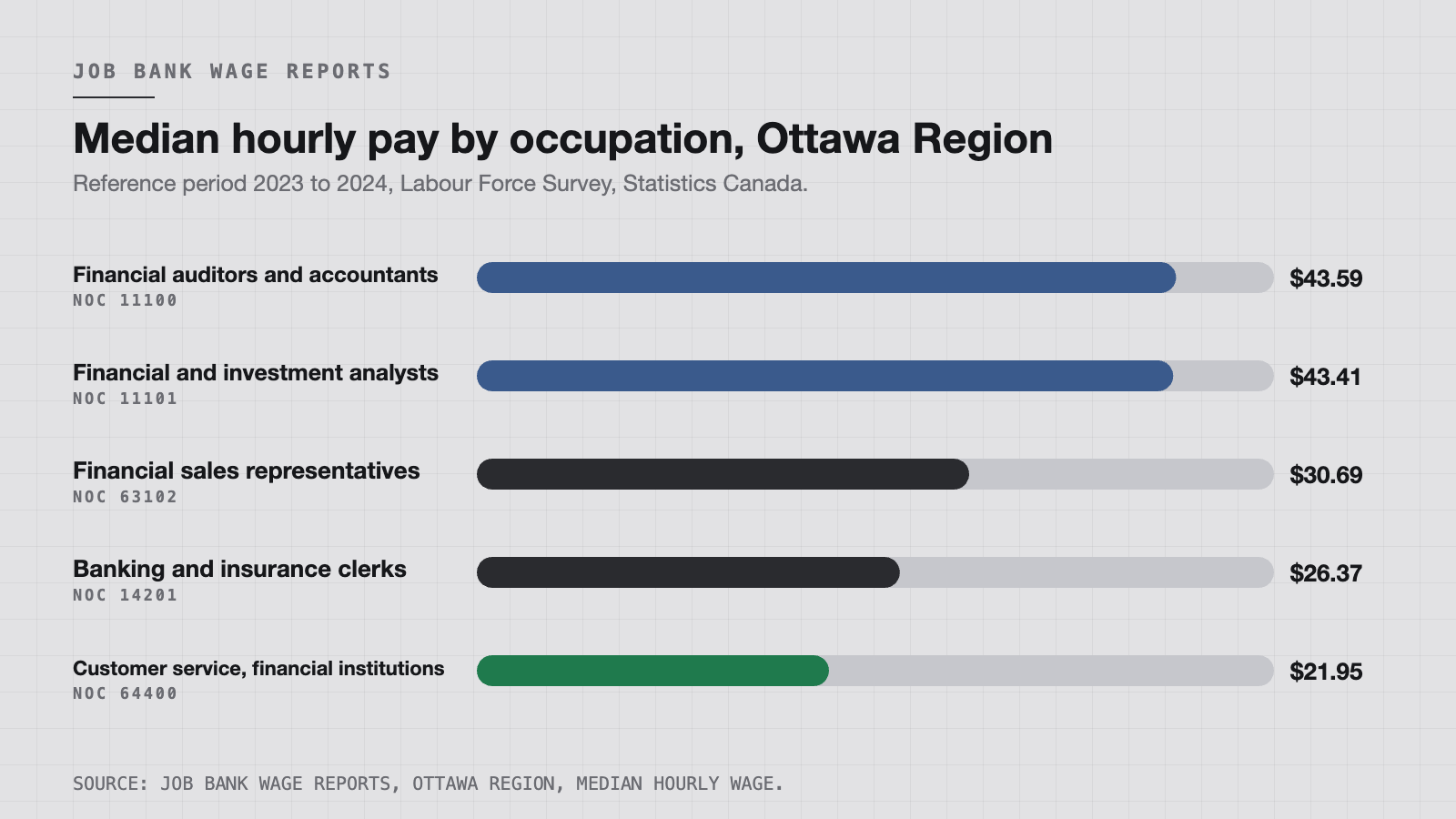
The spread between the front line and the analytical roles is the single most important thing on that chart. A customer service job at a bank and an analyst job at the same bank are separated by roughly twenty dollars an hour at the median, and the gap is mostly explained by credentials and by whether the work is transactional or analytical.
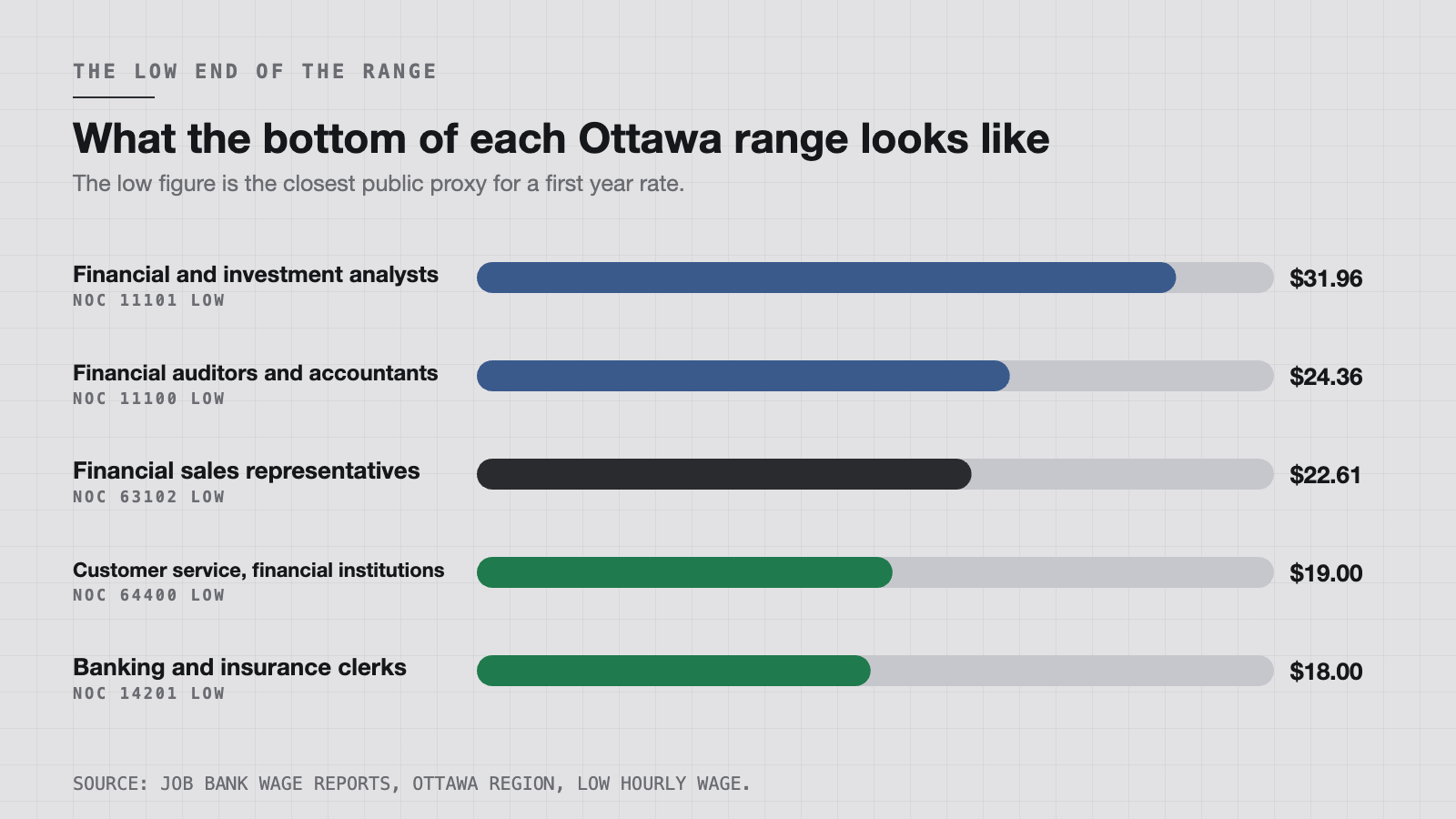
- Customer services representatives, financial institutions (NOC 64400) in the Ottawa Region: low $19.00, median $21.95, high $29.23 per hour.
- Banking, insurance and other financial clerks (NOC 14201): low $18.00, median $26.37, high $34.72.
- Financial sales representatives (NOC 63102), the family that covers most client advisor and personal banking roles: low $22.61, median $30.69, high $45.04.
- Financial and investment analysts (NOC 11101): low $31.96, median $43.41, high $62.05.
- Financial auditors and accountants (NOC 11100): low $24.36, median $43.59, high $69.22.
Two of those ranges deserve a note. Ottawa pays a higher low wage for analysts than the national figure of $28.21, which is consistent with a market where the federal government, Crown corporations and defence contractors compete for the same graduates as the banks. Ottawa also has a lower high wage for analysts than Toronto, because the very top of the analyst range sits in capital markets, and Toronto has more of it.
Which number applies to you
If you are graduating and applying to your first permanent role, the low figure is the closest public proxy for what you will be offered. The median describes someone with a few years in the seat, and the high figure usually reflects seniority, a licence, a book of business or a specialised desk. Students routinely quote the median in interviews and then look surprised when the offer arrives well below it.
There is one important caveat. Job Bank reports hourly wages, and many analyst and accounting roles are salaried with a bonus. To convert, multiply the hourly figure by roughly 1,950 to 2,080 hours for a full year, then treat any bonus as separate. An analyst at the Ottawa low of $31.96 an hour is somewhere close to sixty five thousand dollars a year before bonus, which is a much more defensible number to bring into a conversation than a round guess.
What the published range does not include
The wage report covers base pay only. It does not price the pension, the benefits plan, tuition support for the licensing courses you will need, or the internal mobility that makes a bank job worth taking at a lower starting rate. Those items are often worth more to a new graduate than a two dollar an hour difference, particularly where an employer pays for licensing.
It also does not capture how quickly pay moves. Front line bank roles tend to have compressed ranges and predictable increases. Analytical roles have wider ranges, which means the same title can pay very differently three years in depending on the desk you land on.
How to use this in an actual conversation
- Quote a range, not a point. Anchor the bottom of your range at or just above the published low for the occupation in your region.
- Name your source. Saying that Job Bank puts the Ottawa median for the occupation at a specific figure is far stronger than saying you did some research.
- Ask what the posted range is before you name a number, and ask where in that range a first year hire normally starts.
- Ask separately about licensing support. If the employer pays for your regulatory exams, that is worth real money in your first two years.
- Do not compare yourself to a Toronto number unless you are applying in Toronto. The Ottawa low for financial sales representatives is actually higher than the Toronto low, and the Toronto high is higher than the Ottawa high.
You can check which local employers are currently posting entry level and student facing roles on our Ottawa new hirings page, then look up the matching occupation on Job Bank before you apply.
Sources
- Job Bank, Search Wages, Employment and Social Development Canada. Wage reports for NOC 64400, 14201, 63102, 11101 and 11100, Ottawa Region.
- Job Bank, job requirements for financial analysts in Canada. Education and designation requirements for NOC 11101.
- Job Bank wage data is drawn from the Labour Force Survey, Statistics Canada, reference period 2023 to 2024.
Details from the organizer’s page. Confirm the date, price and registration with the organizer before you go. Shown as $0.00 when the organizer lists no cost.
Posted July 25, 2026