
Most students prepare for interviews by collecting questions and writing answers to them. That is the wrong unit of work. Interviewers are not scoring your answers individually, they are trying to resolve one question, and if you know what that question is you can prepare far less material and use it much better.
Harvard’s Mignone Center for Career Success puts it plainly: during an interview, employers ultimately want to know why they should hire you. Everything else is a way of getting at that. The centre lists five things employers try to assess, and each one maps to something you can actually prepare.
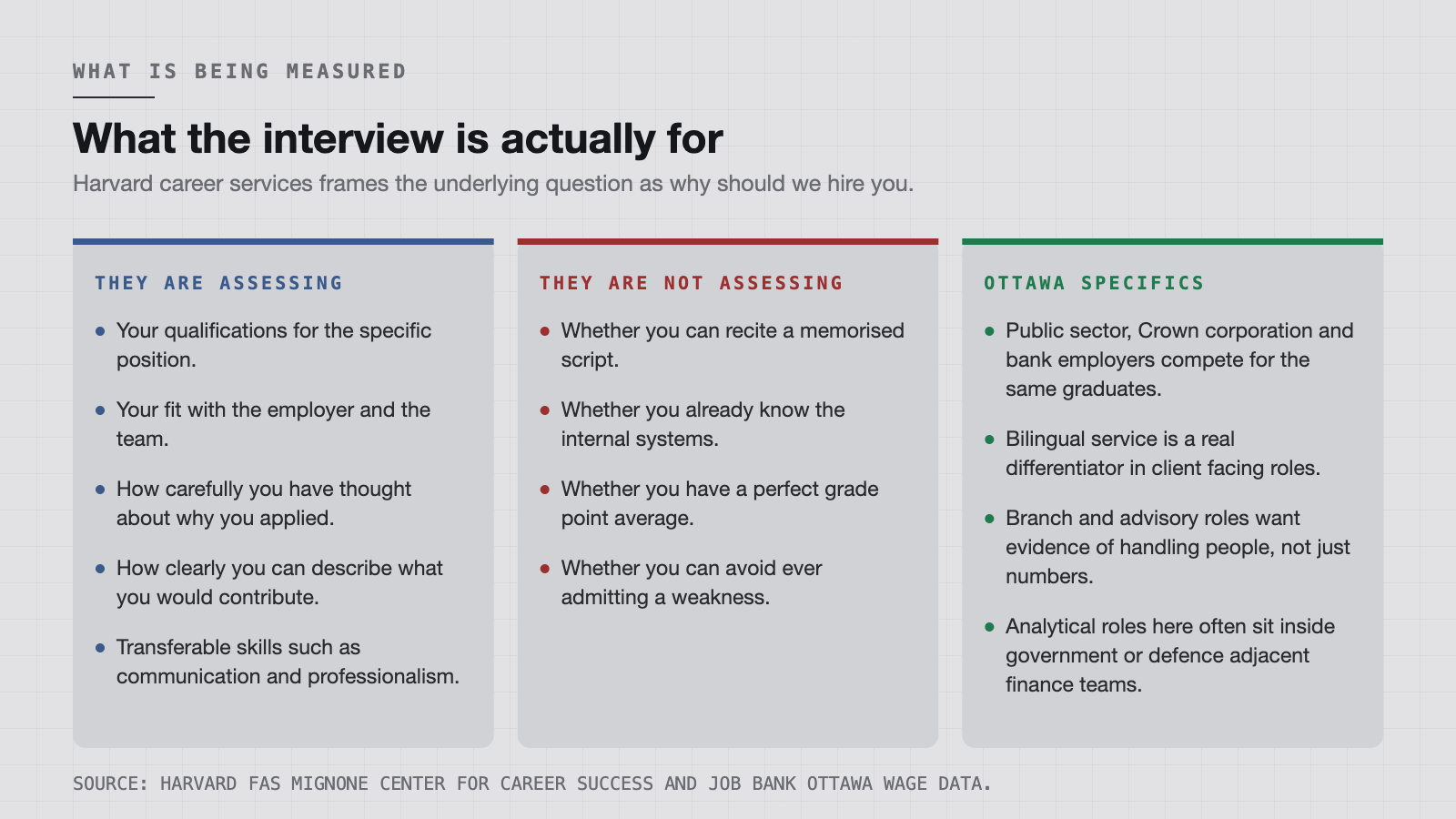
The five things being assessed
The list is your qualifications for the position, your fit with the employer or organisation, how carefully you have considered your reasons for applying, how clearly you can express your potential contributions, and your transferable skills such as communication and professionalism. Notice that only the first item is about your credentials. The other four are about judgement and articulation, which is why a candidate with a weaker transcript regularly beats a stronger one.
The practical implication is that a page of memorised answers is a poor investment. A short set of real experiences you can describe precisely is a much better one, because the same experience can answer a teamwork question, a conflict question and a why finance question depending on which part you emphasise.
Finance interviews have two halves
Technical interviews are common in finance, and Harvard’s guidance is that they assess two things at once: fit for the job and the organisation, and technical knowledge. The fit half uses the questions you expect, including tell me about yourself and why you are interested in this organisation, and often includes behavioural questions. The technical half is specific to the desk you are applying to.
For entry level roles in Ottawa that usually means product knowledge rather than modelling. If you are interviewing for a client facing role, you should be able to explain the difference between a registered and non registered account, what a mutual fund fee actually pays for, and why a client with short term goals should not be in a long term product. If you are interviewing for an analytical role, expect questions about how you would check whether a number is wrong.
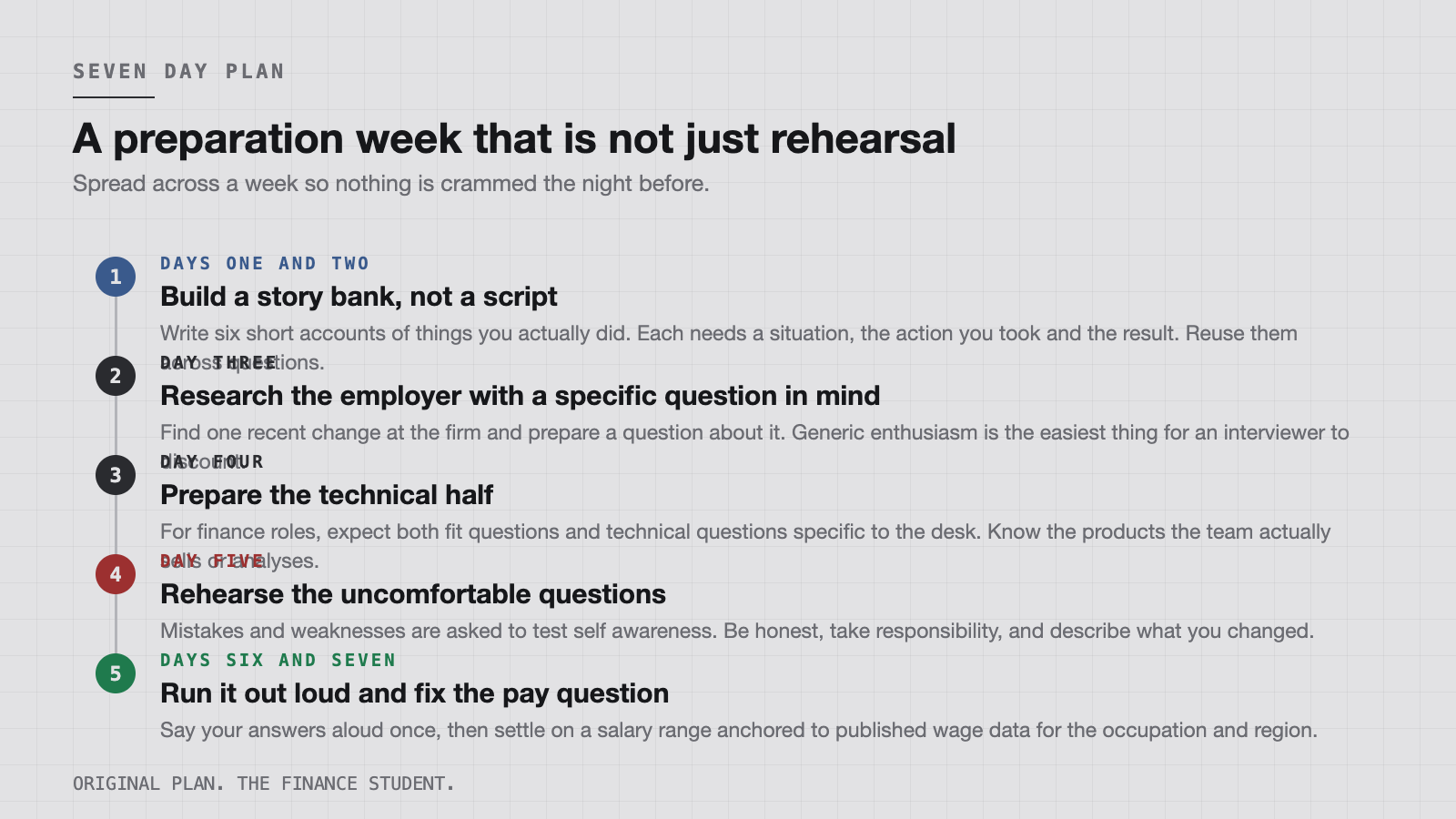
Build a story bank instead of a script
Write six short accounts of things you have actually done. Each one needs three parts: the situation, the action you took, and the result of that action. Harvard’s guidance on behavioural questions is explicit about this structure, and the reason it works is that interviewers are usually taking notes against a competency list rather than judging your prose.
Six is enough for almost any entry level interview. Pick experiences that differ in kind rather than in setting: one where you led something, one where you fixed a mistake, one where you dealt with a difficult person, one where you handled numbers or money carefully, one where you learned something quickly, and one where you failed and adjusted.
The questions students handle worst
Negatively framed questions are the ones that ruin otherwise good interviews. Harvard’s advice is that these questions exist to test how you handle difficulty and how much insight you have into yourself, and that the right approach is to be honest, take responsibility, focus on behaviours rather than personality traits, and describe what you are doing to improve. A weakness answer that names a real behaviour and a specific correction reads as maturity. One that names a strength in disguise reads as evasion.
The pay question, answered with data
Do not improvise a number. Job Bank publishes wage ranges by occupation and region, and for the Ottawa Region the median for financial sales representatives, the family that covers most client advisor and personal banking roles, is $30.69 per hour, with a low of $22.61. Anchoring the bottom of your range near the published low for a first year hire is defensible and easy to explain. We break the Ottawa numbers down role by role in our piece on what entry level finance roles actually pay in Ottawa.
Two things to do on the day
- Bring one question about something specific and recent at the employer. It is the fastest way to demonstrate that you considered your reasons for applying.
- Bring a printed one page resume even for a video interview. It gives you something to point at and keeps your own timeline straight.
For a list of Ottawa employers currently posting entry level and student facing roles, see our Ottawa new hirings page.
Sources
- Harvard FAS, Mignone Center for Career Success, Interviewing. What employers assess, behavioural and fit interviews, negatively framed questions, and technical and finance interviews.
- Job Bank, wage report for financial sales representatives. Ottawa Region low, median and high hourly wages.
- Job Bank, prepare for an interview. Canadian interview preparation resources.
Details from the organizer’s page. Confirm the date, price and registration with the organizer before you go. Shown as $0.00 when the organizer lists no cost.
Posted July 26, 2026