Students picture the junior analyst job as the part of finance where you build things. In practice the first year is mostly about maintaining things other people built, finding numbers quickly, and being able to explain where each one came from. That is less glamorous than the pitch, and it is also the part that determines whether you get interesting work in year two.
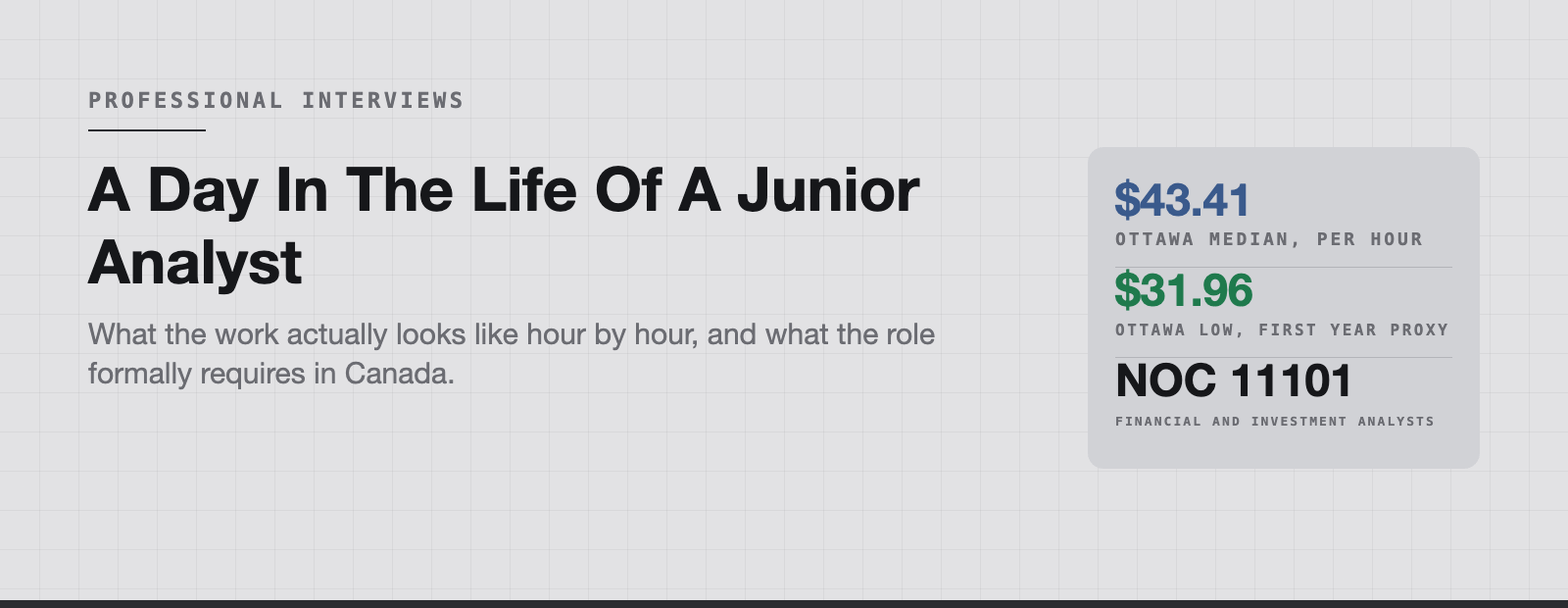
Two things are worth setting out before the hour by hour version. The occupation has a formal definition in Canada, financial and investment analysts under NOC 11101, and it has published pay. In the Ottawa Region, Job Bank puts the median at $43.41 an hour with a low of $31.96 and a high of $62.05. The low figure is the closest public proxy for a first year rate.
The first hour is triage
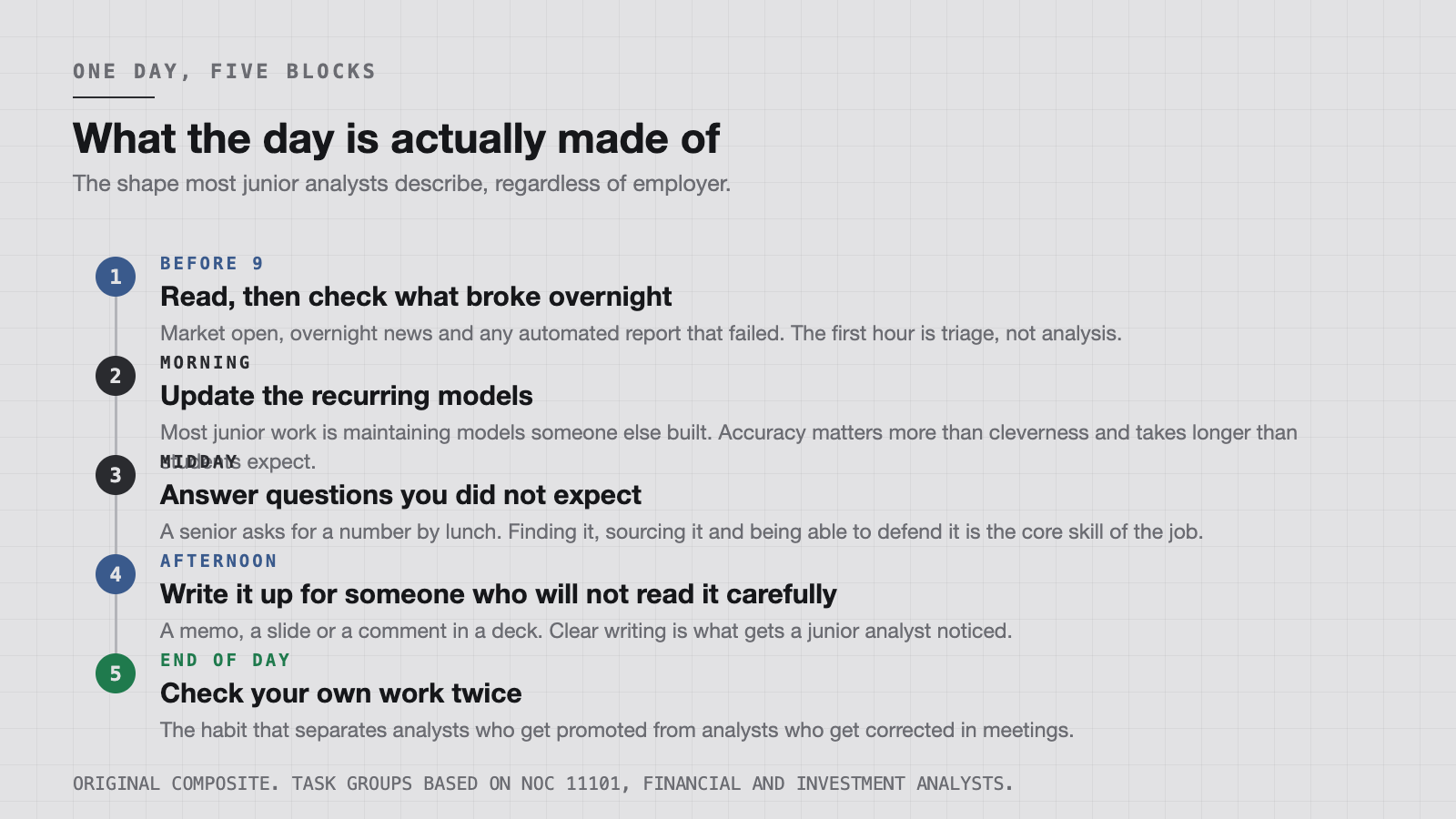
The day does not start with analysis. It starts with finding out what changed overnight and what broke. Automated reports fail, data feeds arrive late, and a number that was right yesterday is wrong this morning for a reason nobody has written down yet. Juniors who treat this hour as administrative overhead spend the rest of the day defending numbers they did not verify.
Most of the morning is maintenance
The single biggest gap between student expectation and the job is that you inherit models rather than build them. Someone senior built the template two or three years ago, it has been patched repeatedly, and your job is to update it correctly and notice when an input no longer makes sense. This is slower than students expect, and it rewards patience over speed.
It is also where the technical interview question about checking whether a number is wrong comes from. Every analyst has a method: reconcile a total against a second source, sanity check a growth rate against history, look at the sign before the magnitude. Having one is a hiring signal.
The midday request is the actual job
At some point a senior asks for a number before a meeting. The skill being tested is not calculation, it is retrieval and defensibility. Can you find it, can you say where it came from, and can you say how confident you are. An analyst who produces a number with a source and a caveat is more useful than one who produces a more precise number with neither.
What the role formally requires
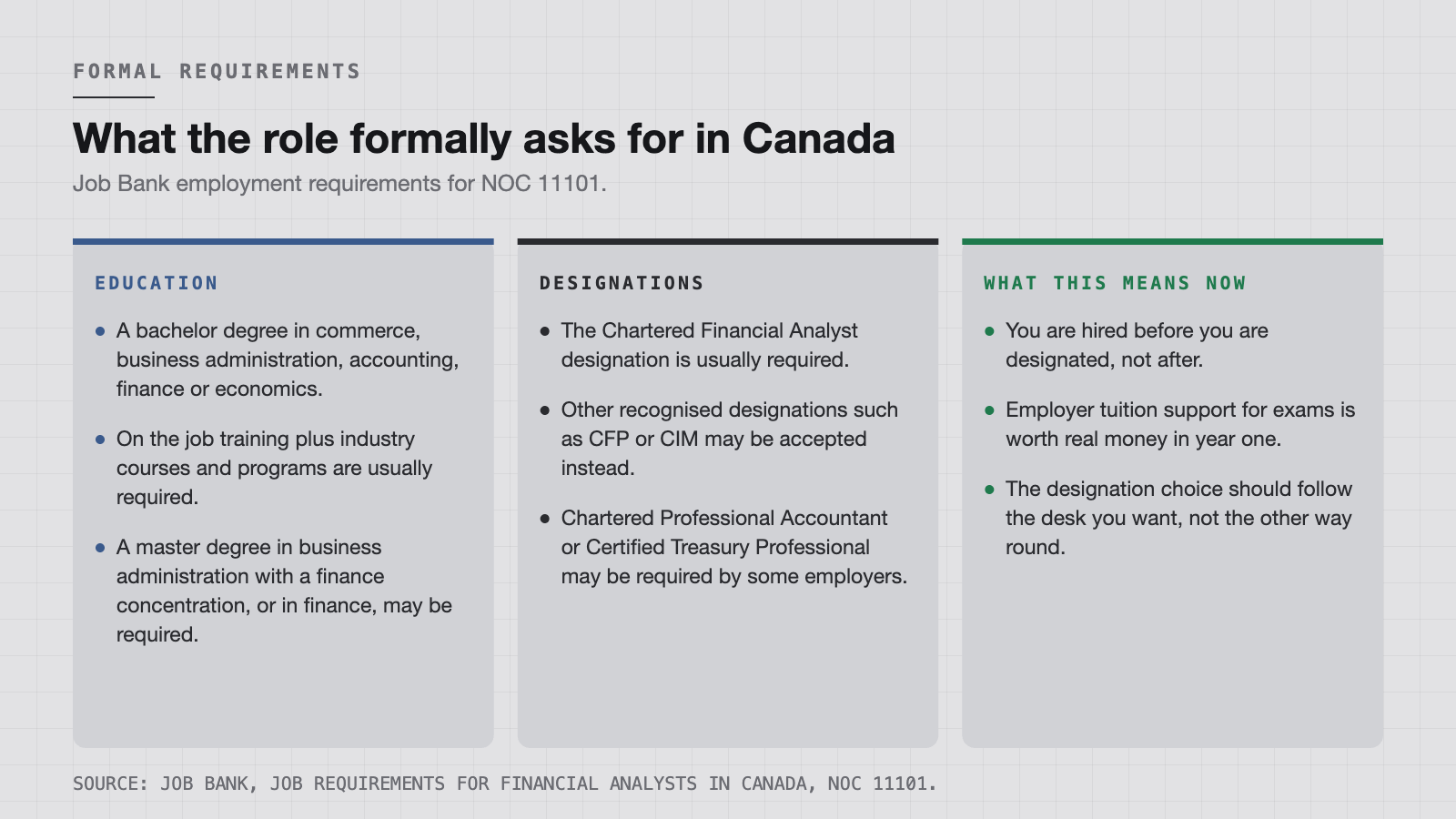
Job Bank lists a bachelor degree in commerce, business administration, accounting, finance or economics, plus on the job training and industry courses, as the typical requirement. A master degree in business administration with a finance concentration, or in finance, may be required. It also states that the Chartered Financial Analyst designation, or another recognised designation such as CFP or CIM, is usually required, and that some employers may require a Chartered Professional Accountant or Certified Treasury Professional designation.
Read that ordering carefully. The designation is described as usually required for the occupation, not for entry into it. In practice you are hired first and designated later, which is why employer tuition support for exams is worth more in your first two years than a small difference in starting salary. If your offer includes paid exam registration and study leave, that is real compensation.
What the Ottawa version of this job looks like
Ottawa is not Toronto, and the difference shows up at the top of the range rather than the bottom. Job Bank puts the Ottawa low for analysts at $31.96 an hour against a national low of $28.21, which reflects competition for graduates between banks, the federal government, Crown corporations and defence adjacent employers. The Ottawa high of $62.05 sits below the national high of $72.36, because the very top of the analyst range lives in capital markets and most of that is in Toronto.
The practical read for a student is that Ottawa is a strong place to start and a market you may need to leave to reach the top of the pay band. Plenty of analysts do the first three years here and then decide, which is a reasonable plan rather than a compromise.
What to ask in an interview for one of these roles
- Whose models will I be maintaining, and how old are they.
- What does the first ninety days look like, specifically.
- Does the firm pay for designation exams, and is there study leave.
- How often does a junior analyst present their own work to someone senior.
- What is the most common reason a junior in this team does not work out.
For current Ottawa postings in analytical and client facing finance roles, see our Ottawa new hirings page, and for the full pay picture see what entry level finance roles actually pay in Ottawa.
Sources
- Job Bank, job requirements for financial analysts in Canada, Employment and Social Development Canada. Employment requirements and designations for NOC 11101.
- Job Bank, wage report for financial and investment analysts. Ottawa Region and national low, median and high hourly wages, reference period 2023 to 2024.
- CFA Institute, CFA Program curriculum. Structure and time commitment of the designation referenced in the occupation requirements.
Details from the organizer’s page. Confirm the date, price and registration with the organizer before you go. Shown as $0.00 when the organizer lists no cost.
Posted July 27, 2026