
If your plan involves working at an investment dealer, the most important thing that happened in Canadian finance this year is a rule change that received almost no coverage aimed at students. On 1 January 2026 the route to being approved at an investment dealer stopped running through a course and started running through an exam. The course most students were told to buy no longer serves that purpose.
This is worth getting right, because the mistake is expensive and easy to make. A student can spend several hundred dollars and several months on a credential that is still respectable but no longer does the specific job it used to do.
Nine exams, no mandated course
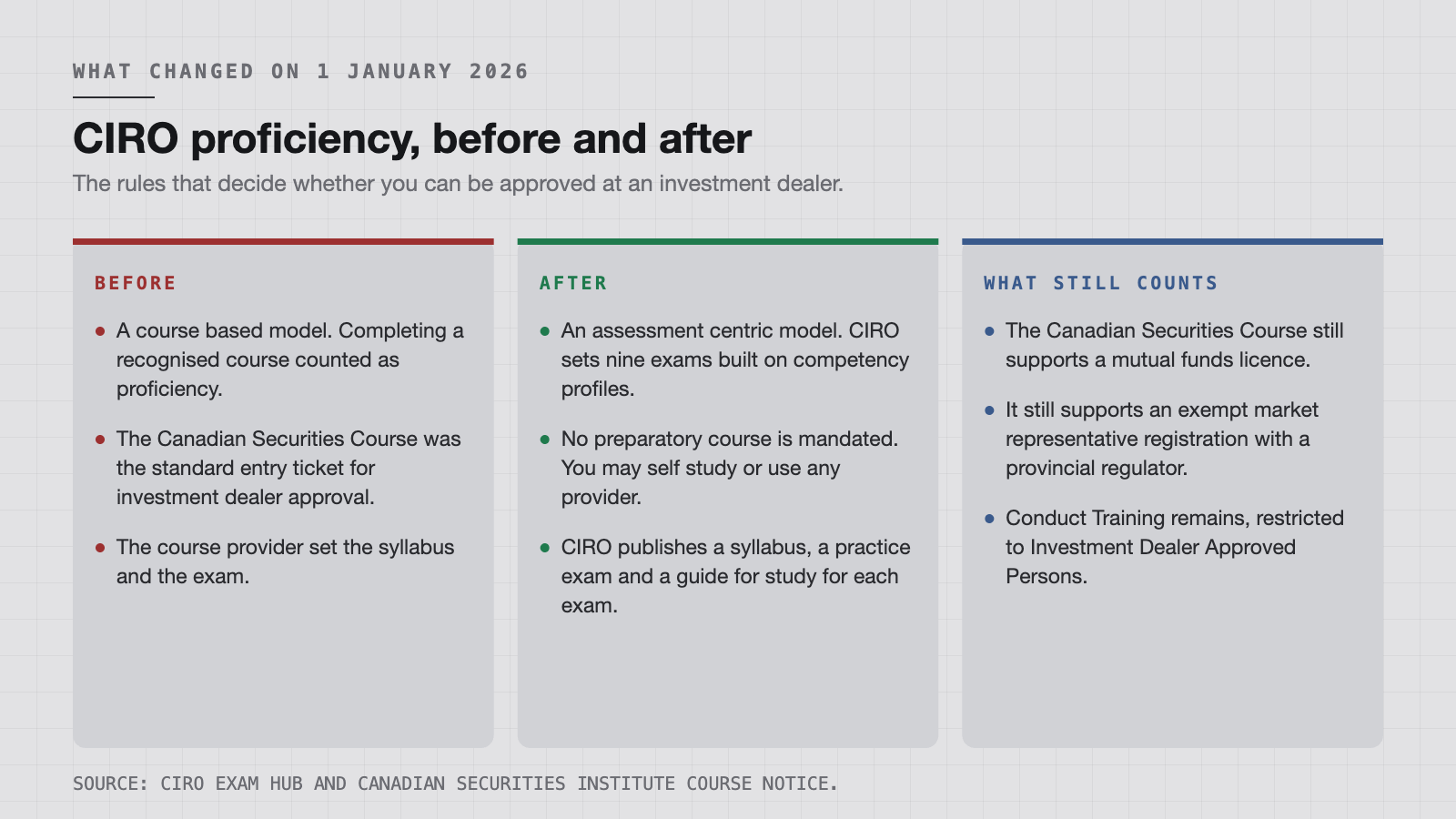
According to CIRO’s Exam Hub, as of 1 January 2026 CIRO proficiency is assessed through nine examinations based on competency profiles. The nine are the Canadian Investment Regulatory Exam, the Retail Securities Exam, the Institutional Securities Exam, the Director and Executive Exam, the Supervisor Exam, the Chief Compliance Officer Exam, the Chief Financial Officer Exam, the Derivatives Exam and the Trader Exam.
The deliberate design choice is what follows. CIRO’s guidance for new candidates states that the new proficiency model does not mandate preparatory courses to study for exams, which is intended to give candidates flexibility in how they prepare. CIRO describes the approach as assessment centric, and says it does not maintain a list of education providers.
In place of a prescribed course, CIRO publishes materials for each exam. The Exam Hub carries syllabi, sample or practice exams and guides for study, described as tools for education providers who wish to offer preparatory courses and for candidates pursuing self directed study. For a student on a budget, that is a genuine change: the official syllabus and a practice exam are available without buying anything.
What happened to the Canadian Securities Course
The Canadian Securities Course has been the default first credential in Canadian finance for decades, and its status has narrowed rather than disappeared. the Canadian Securities Institute now states on the course page that effective 1 January 2026 the proficiency rules applicable to Investment Dealer Approved Persons with CIRO have changed, and that the course is no longer acceptable for the purposes of CIRO approval with an investment dealer.
It still does several things. The institute lists the course as meeting proficiency requirements to deal in mutual funds, as relevant for an exempt market representative licence with a provincial regulator, and as relevant for dealing in alternative mutual funds for retail investors. It remains a reasonable general foundation in Canadian financial products, and plenty of employers still regard it as a signal of seriousness on a resume.
What it no longer is, is the ticket to a registered representative role at an investment dealer. If that is your target, the CIRO exams are the requirement and the course is optional preparation for them.
The order this actually happens in
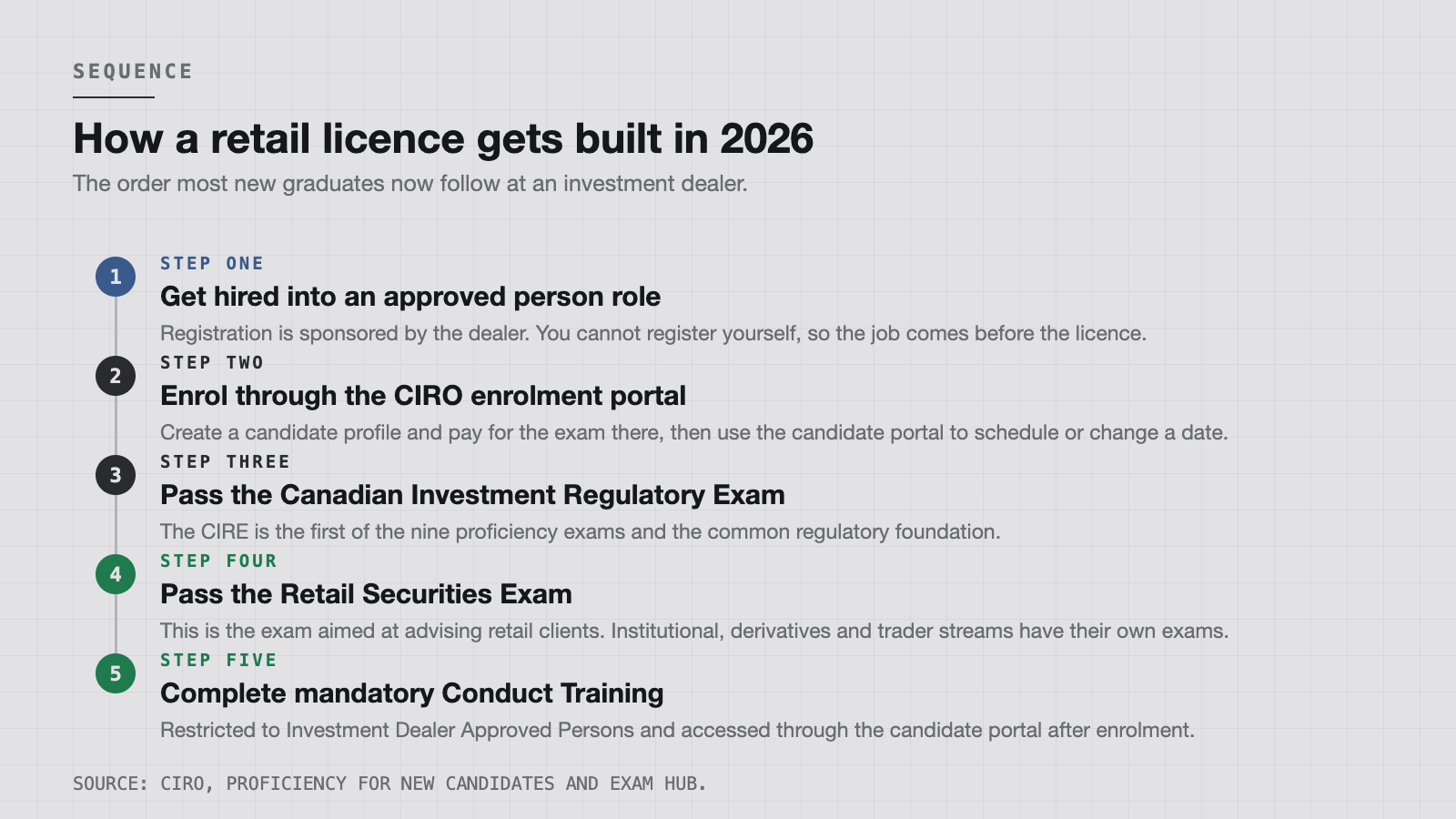
The sequencing surprises students most. You do not get licensed and then get hired. Registration as an approved person is sponsored by the dealer, which means the job comes first. After that, enrolment runs through CIRO’s enrolment portal, where you create a candidate profile and pay for an exam, and scheduling runs through a separate candidate portal that you can only use after enrolling.
For a graduate heading into retail wealth or branch advice, the practical path is the Canadian Investment Regulatory Exam followed by the Retail Securities Exam. Other streams have their own exams: institutional, derivatives and trader roles each have a dedicated assessment, and the supervisory, executive and officer exams sit above all of them.
Conduct Training also remains, and CIRO is explicit that it is restricted to Investment Dealer Approved Persons. The organisation warns that misrepresenting your status when enrolling can result in a ban from the enrolment site, a requirement to retake the training, imposition of the fee, or other regulatory action. This is not a course to sign up for speculatively.
What to do with this if you are still in school
- Do not buy a securities course on the assumption that it licenses you. Confirm what CIRO requires for the specific approval category you want first.
- Download the syllabus and practice exam for the Canadian Investment Regulatory Exam from the Exam Hub. They are published and cost nothing.
- If a mutual funds licence or an exempt market registration is your actual target, the Canadian Securities Course still applies.
- Ask in interviews whether the employer pays for CIRO exam enrolment. Under the new model that cost sits with the candidate unless the employer covers it.
- Do not enrol in Conduct Training unless you are an Investment Dealer Approved Person.
For the accounting and analysis routes, including the new CPA program expected in 2027 and the CFA Level III pathways, see our piece on licensing changes CPA and CFA candidates should watch. For provincial rule changes in progress, see our securities rules watchlist.
Sources
- CIRO’s Exam Hub, Canadian Investment Regulatory Organization. Nine proficiency examinations effective 1 January 2026, published syllabi, practice exams and study guides, and the Conduct Training restriction.
- CIRO’s guidance for new candidates. The assessment centric model and the statement that no preparatory courses are mandated.
- the Canadian Securities Institute, Canadian Securities Course. Notice that the course is no longer acceptable for CIRO investment dealer approval, and the registrations it still supports.
Details from the organizer’s page. Confirm the date, price and registration with the organizer before you go. Shown as $0.00 when the organizer lists no cost.
Posted July 31, 2026