
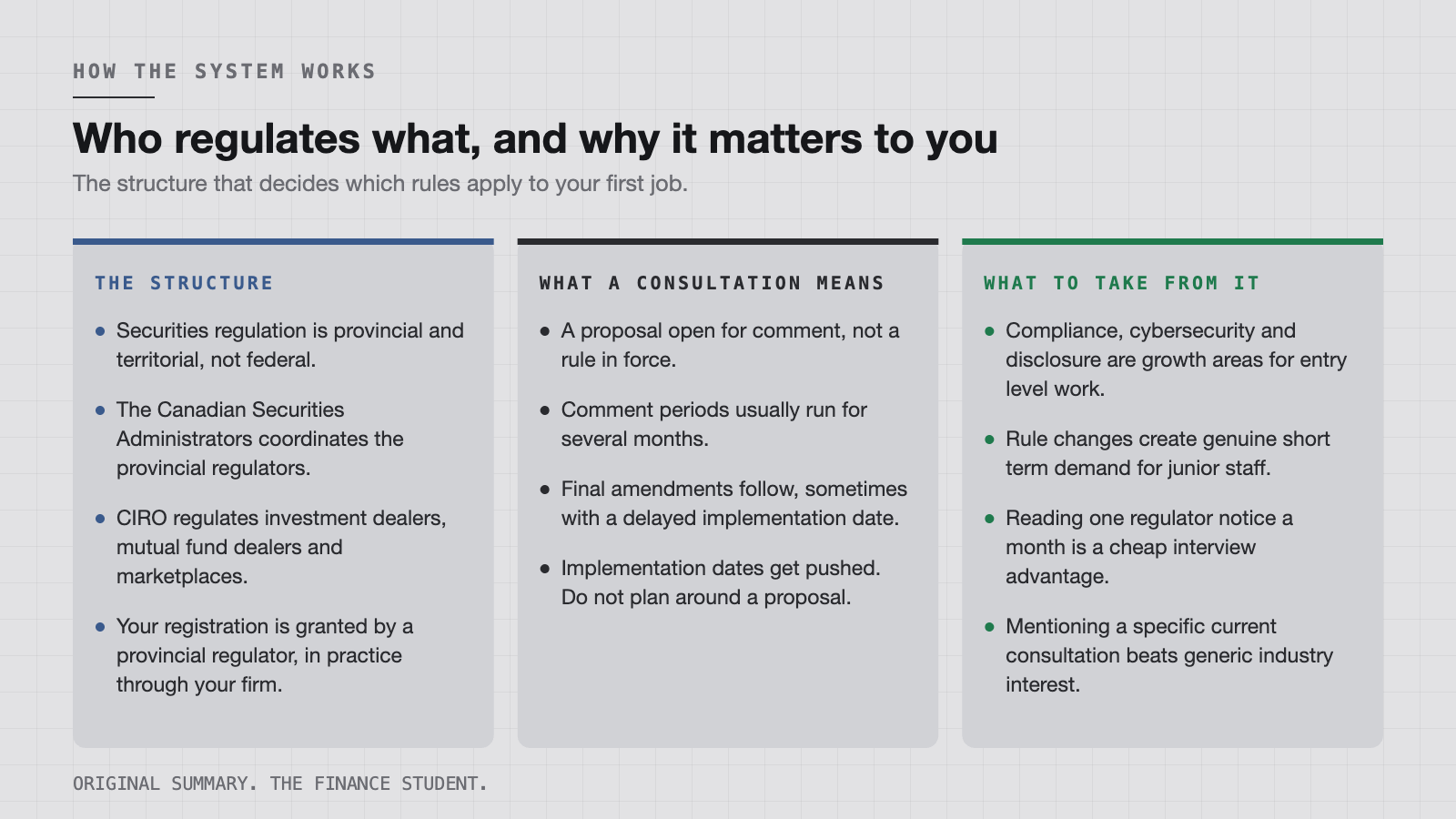
There is no national securities regulator in Canada. Securities law is provincial and territorial, and the thirteen regulators coordinate through an umbrella body called the Canadian Securities Administrators. That structure sounds like a technicality until you realise it decides which rules apply to your first registered job, and that the people who track those rules are among the few finance functions hiring steadily.
You do not need to become a compliance specialist to benefit from this. Reading one regulator notice a month is enough to give you something specific to say in an interview, which is more than most candidates bring.
What moved in a single month
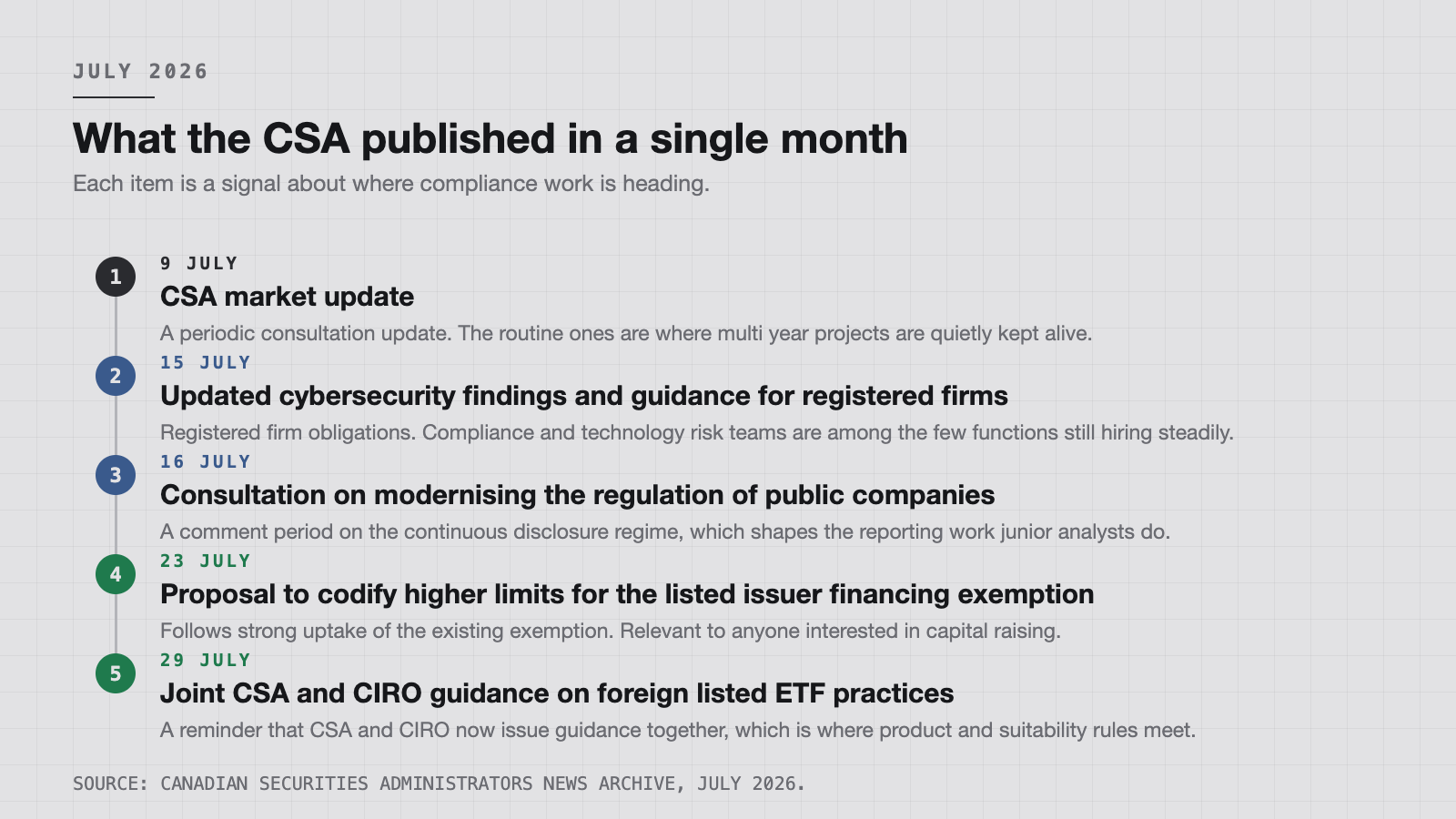
July 2026 is a fair sample of the pace. According to the Canadian Securities Administrators news archive, five items were published in the space of three weeks, and each one points at a different kind of work.
- On 9 July, a CSA market update, filed under consultations. Routine updates are where long running projects are kept alive between milestones.
- On 15 July, updated cybersecurity findings and guidance for registered firms. Technology risk and compliance obligations for registrants continue to expand.
- On 16 July, a request for comment on modernising the regulation of public companies. The continuous disclosure regime is what generates most of the reporting work junior analysts do.
- On 23 July, a proposal to codify higher limits for the listed issuer financing exemption, following what the CSA described as strong uptake of the existing exemption.
- On 29 July, joint guidance from the CSA and CIRO on foreign listed exchange traded fund practices.
The June items are worth a mention too. On 25 June the CSA announced final amendments to implement an access model for certain continuous disclosure documents of reporting issuers other than investment funds, and on 22 June the CSA and CIRO said they would delay implementation of final amendments in another area. That combination is the pattern in miniature: rules land, and implementation dates move.
Consultation is not law
The most common mistake students make when they start reading regulator notices is treating a proposal as a rule. A consultation is a document open for comment. Comment periods typically run for months, final amendments follow, and implementation dates are frequently delayed. Nothing in a consultation obliges you or your future employer to do anything yet.
The useful signal in a consultation is directional rather than operational. When a regulator opens a comment period on modernising public company regulation, it is telling you that reporting requirements will change over the next few years and that firms will need people who understand the new regime. That is a hiring signal, not a compliance deadline.
Where your registration actually comes from
For a student, the division of labour is worth committing to memory. Provincial and territorial regulators make and enforce securities law in their jurisdictions. The CSA coordinates them and publishes harmonised instruments and guidance. CIRO regulates investment dealers, mutual fund dealers and marketplace activity, and sets the proficiency requirements you have to meet to be an approved person.
In practice you never deal with the provincial regulator directly at the start of your career. Your firm sponsors your registration and files it. But the rules being applied to you are provincial, which is why a role in Ontario and the same role in British Columbia can have slightly different requirements, and why the Canadian Securities Course still supports an exempt market representative licence with a provincial regulator even after CIRO stopped accepting it for investment dealer approval.
Why compliance is a reasonable place to start a career
Compliance is unglamorous and it is hiring. Every one of the July items above creates work: guidance has to be read and applied, disclosure processes have to be rebuilt, and exemptions have to be documented correctly. Firms staff that work with a mix of experienced specialists and junior analysts, and the junior end is accessible to a graduate with a commerce or finance degree and no designation.
It is also a good place to learn how a firm actually operates. Compliance sees every desk. Two years there gives you a map of the business that a graduate on a single product desk will not have for a decade.
A ten minute monthly habit
- Open the CSA news archive once a month and read the headlines for the last four weeks.
- For anything labelled a consultation, note the topic and ignore the detail.
- For anything labelled final amendments, note the implementation date.
- Keep one sentence about the most relevant item for your next interview.
- Check CIRO separately, since proficiency and dealer conduct rules are published there rather than by the CSA.
For the licensing side of this, see our guides to the CIRO proficiency change and what CPA and CFA candidates should watch.
Sources
- the Canadian Securities Administrators news archive. Items dated 9, 15, 16, 23 and 29 July 2026, and 22 and 25 June 2026.
- Canadian Securities Administrators. Structure and role of the umbrella organisation coordinating provincial and territorial regulators.
- CIRO, Exam Hub. Proficiency requirements for approved persons at investment dealers.
Details from the organizer’s page. Confirm the date, price and registration with the organizer before you go. Shown as $0.00 when the organizer lists no cost.
Posted July 31, 2026