
Hybrid work stopped being a single trend some time in 2025. It is now a patchwork, and the patch you land in is decided by your employer and sometimes by your province. For a student choosing between offers, that makes the in office requirement one of the few terms worth asking about directly, because it changes your real income through commuting and housing more than a small difference in salary does.
Here is where things actually stood in 2026, using what employers and governments have publicly confirmed.
Two provincial public services went back to five days
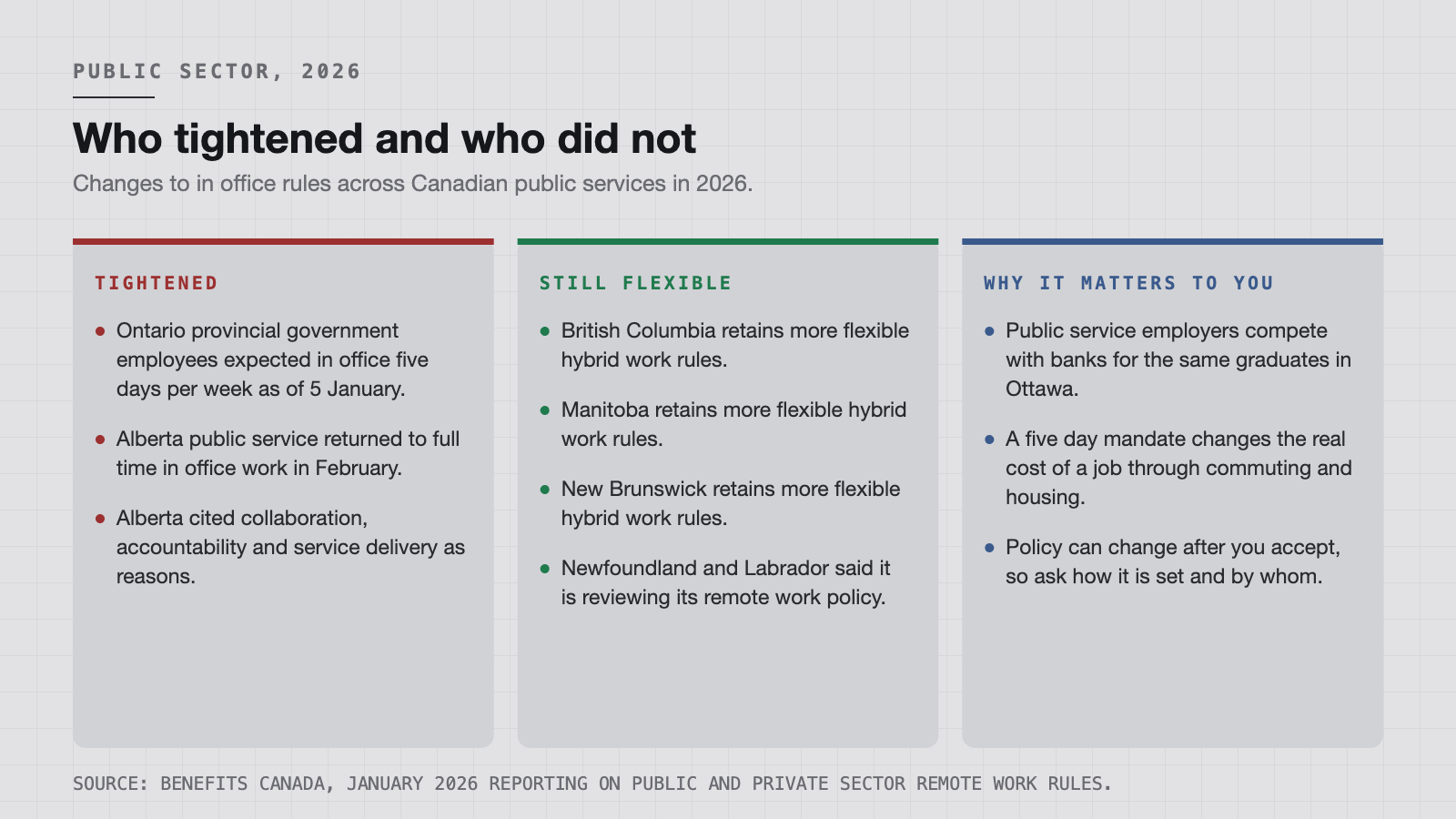
As of 5 January 2026, Ontario provincial government employees are expected to work in the office five days per week, according to Benefits Canada. Alberta’s public service also returned to full time in office work in February, with a government spokesperson citing the aim of strengthening collaboration, accountability and service delivery.
That is not a nationwide reversal. The same reporting noted that British Columbia, Manitoba and New Brunswick retain more flexible hybrid work rules, while Newfoundland and Labrador said it was reviewing its remote work policy. In other words, the direction of travel depends on the employer, and public sector policy is now a genuine differentiator between otherwise similar jobs.
For students in Ottawa this matters more than it does almost anywhere else in the country. Federal and provincial employers, Crown corporations and the banks compete for the same graduates here, so the in office requirement is often the clearest difference between two offers at similar pay.
The private sector gap between preference and provision
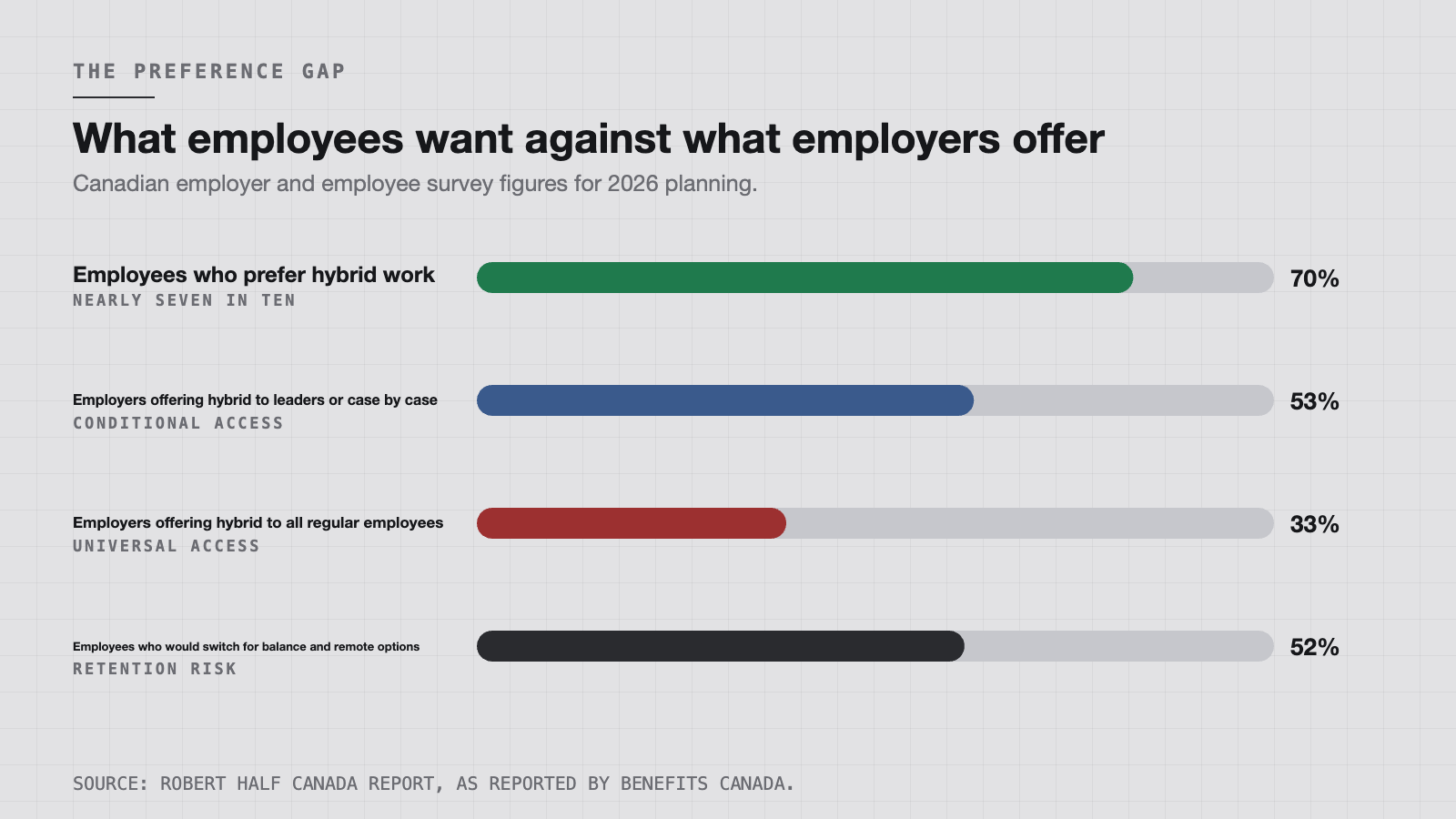
On the private side, the Robert Half Canada report found that nearly seven in ten employees say hybrid work is their preferred arrangement. Provision does not match that. Just over half of employers, 53 per cent, said they offer hybrid options to those in leadership roles and on a case by case basis, while only a third, 33 per cent, offer them to all regular employees.
Read those two figures together and the implication for a new graduate is uncomfortable but useful. Hybrid access is frequently a seniority benefit rather than a universal policy. If a job description mentions flexibility, it is worth asking whether that applies to your specific role and level or only to the team leads.
Flexibility is being tied to retention, not just preference
The same research found that 52 per cent of employees would switch jobs for better work life balance and remote working options, ranking it the single highest reason for moving. That is why the policy question is live rather than settled: employers pulling people back into offices are trading against a measurable retention cost, and many are trying to find a middle position rather than a mandate.
There is also a growing argument that how a mandate is set matters as much as what it requires. Writing in Benefits Canada, July 2026, Latifa Soobedar, a clinical psychologist at Serefin Health, argued that return to office policies should reflect legitimate business needs rather than individual leaders’ preferences. The article referenced a Wharton School study, based on an analysis of 259 Fortune 500 chief executives plus a survey of more than 350 company leaders and an experiment with more than 500 managers, which found that narcissistic traits predicted greater resistance to remote work, with motivations around power and status helping explain the relationship.
You cannot screen an employer for that in an interview. You can ask a related and entirely reasonable question: how is the in office requirement decided, and at what level. An employer that can describe a process is in a different position from one that describes a preference.
What to ask before you accept
- How many days in office are required for my specific role and level, in writing.
- Is the policy set nationally, by division, or by individual manager.
- Has the requirement changed in the last twelve months, and is a review planned.
- Are core hours or anchor days fixed, and can they change without notice.
- If the requirement increases, does anything else change, such as a commuting allowance.
How to price it
Convert the requirement into money before you compare offers. Five days in office against three days is roughly ninety extra commutes a year. At Ottawa transit and parking costs that is a meaningful sum, and if it pushes you into living closer to downtown the housing difference will dwarf it. A job paying slightly less with two fewer required days is frequently the better financial outcome, and almost no student does this arithmetic before accepting.
For the rest of the compensation picture, see our guide to how benefits are doing the work salaries used to do and what entry level finance roles actually pay in Ottawa.
Sources
- Benefits Canada, January 2026. Ontario provincial government five day in office expectation from 5 January, Alberta public service return in February, and the position of British Columbia, Manitoba, New Brunswick and Newfoundland and Labrador.
- the Robert Half Canada report, as reported by Benefits Canada. Employee hybrid preference, employer provision by level, and willingness to switch jobs for balance and remote options.
- Benefits Canada, July 2026. Commentary from Latifa Soobedar of Serefin Health and the Wharton School study on leader resistance to remote work.
Details from the organizer’s page. Confirm the date, price and registration with the organizer before you go. Shown as $0.00 when the organizer lists no cost.
Posted July 30, 2026